<?xml version="1.0" encoding="utf-8"?><feed xmlns="http://www.w3.org/2005/Atom" xml:lang="en"><generator uri="https://jekyllrb.com/" version="3.10.0">Jekyll</generator><link href="https://sadiqebrahim.github.io/lucidum/feed.xml" rel="self" type="application/atom+xml" /><link href="https://sadiqebrahim.github.io/lucidum/" rel="alternate" type="text/html" hreflang="en" /><updated>2026-10-20T05:08:28+05:30</updated><id>https://sadiqebrahim.github.io/lucidum/feed.xml</id><title type="html">Lucidum</title><subtitle>Longer reads behind Lucidum&apos;s posts: new research in physics, quantum computing and deep tech, explained plainly, with every source linked.</subtitle><entry><title type="html">A bubble of atoms that acts out the birth of a universe</title><link href="https://sadiqebrahim.github.io/lucidum/2026/10/16/bec-bubble/" rel="alternate" type="text/html" title="A bubble of atoms that acts out the birth of a universe" /><published>2026-10-16T23:23:00+05:30</published><updated>2026-10-16T23:23:00+05:30</updated><id>https://sadiqebrahim.github.io/lucidum/2026/10/16/bec-bubble</id><content type="html" xml:base="https://sadiqebrahim.github.io/lucidum/2026/10/16/bec-bubble/"><![CDATA[<p>We can’t rerun the Big Bang. A <a href="https://arxiv.org/abs/2610.20382">new theory proposal</a> suggests the next best thing: a hollow bubble of atoms, cooled to almost absolute zero, that acts out <mark>a tiny, curved universe</mark> on a lab bench.</p>

<h2 id="a-bubble-made-of-one-quantum-wave">A bubble made of one quantum wave</h2>

<p>When atoms are cooled enough they form a Bose-Einstein condensate (BEC), in which they behave together as a single quantum wave. Labs have recently realised BECs in shell-shaped, or “bubble”, traps, a thin hollow sphere of quantum gas. Ruotong Zhai and colleagues ask whether such a bubble can stand in for a universe.</p>

<h2 id="changing-the-sound-speed-stretches-the-space">Changing the sound speed stretches the space</h2>

<p>Sound waves in the condensate travel at a speed set by how strongly the atoms interact. The authors study a quench, a change of that interaction strength over time, either decaying or growing exponentially. They show that, for the sound waves living on the shell, this is mathematically like a positively curved universe whose scale factor changes in time. To the waves, space itself is stretching or shrinking.</p>

<p>That’s the trick of analog gravity: you don’t need to make anything the size of the cosmos. You need equations that match.</p>

<h2 id="pairs-from-nothing-and-theyre-entangled">Pairs from nothing, and they’re entangled</h2>

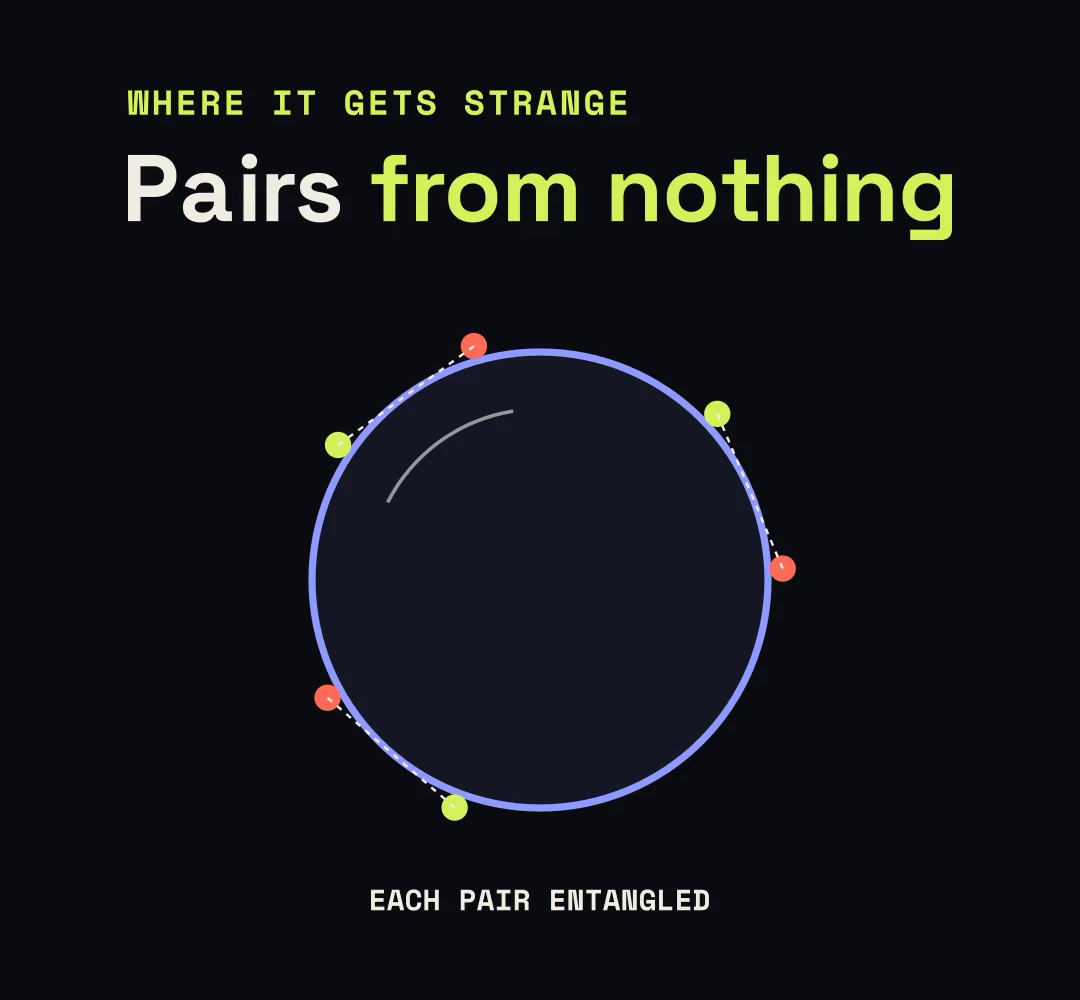
<p>In the early universe, rapidly changing space creates particle pairs out of the vacuum. In the bubble, the same maths makes pairs of excitations, quanta of sound, appear spontaneously when the interaction strength is quenched.</p>

<p><img src="/lucidum/assets/posts/2026-10-16-bec-bubble/pairs.png" alt="A circle representing the atom bubble with pairs of coloured dots appearing on its surface and moving apart, joined by dashed lines." />
<em>Quenching the interactions makes pairs of sound waves appear on the shell, each pair entangled (schematic).</em></p>

<p>These pairs leave a fingerprint: oscillations in the structure factor, a measure of how density ripples are spread across scales. The authors note these are analogous to the Sakharov oscillations in the cosmic microwave background’s angular power spectrum, the ripple pattern astronomers measure in the oldest light in the universe. They also quantify how entangled the pairs are, using a measure called logarithmic negativity, and show it can be extracted from the power spectrum itself.</p>

<h2 id="why-it-matters">Why it matters</h2>

<p>It links quantum information science with early-universe cosmology in a system that could actually be built. Ideas about how particles and correlations emerge from an expanding universe could, in principle, be tested in a controllable experiment.</p>

<h2 id="the-catch">The catch</h2>

<p class="catch">This is a theory proposal and a preprint that hasn’t been peer reviewed. No experiment has been done yet. An analog universe reproduces the maths of certain processes, not the real cosmos, so what it can tell us about the actual Big Bang depends on how far the analogy holds.</p>

<p>To test how a universe begins, you might only need a bubble of very cold atoms.</p>]]></content><author><name></name></author><summary type="html"><![CDATA[We can’t rerun the Big Bang. A new theory proposal suggests the next best thing: a hollow bubble of atoms, cooled to almost absolute zero, that acts out a tiny, curved universe on a lab bench.]]></summary><media:thumbnail xmlns:media="http://search.yahoo.com/mrss/" url="https://sadiqebrahim.github.io/lucidum/assets/img/social.jpg" /><media:content medium="image" url="https://sadiqebrahim.github.io/lucidum/assets/img/social.jpg" xmlns:media="http://search.yahoo.com/mrss/" /></entry><entry><title type="html">A few random codes make AI writing look human</title><link href="https://sadiqebrahim.github.io/lucidum/2026/10/16/ai-authorship/" rel="alternate" type="text/html" title="A few random codes make AI writing look human" /><published>2026-10-16T23:22:00+05:30</published><updated>2026-10-16T23:22:00+05:30</updated><id>https://sadiqebrahim.github.io/lucidum/2026/10/16/ai-authorship</id><content type="html" xml:base="https://sadiqebrahim.github.io/lucidum/2026/10/16/ai-authorship/"><![CDATA[<p>As AI becomes a normal part of writing, the question shifts from “did you use AI?” to “how much of this is yours?” A <a href="https://arxiv.org/abs/2610.19767">new paper</a> shows that a prominent way of answering it can be gamed with a trick: ask the AI to copy a few random codes, and <mark>the same text can score 85% human instead of 15%</mark>.</p>

<h2 id="the-measure">The measure</h2>

<p>One line of work estimates human contribution by asking how predictive your prompt is of the final text. The idea is intuitive: if you supplied a detailed prompt full of your own ideas, the output follows from you, so more of it counts as yours. A vague prompt means the model did more of the work.</p>

<h2 id="the-trick-specificity-padding">The trick: specificity padding</h2>

<p>Hasan Amin, Zhuoran Lu and Ming Yin introduce what they call specificity padding. Put a few random IDs in the prompt and ask the model to copy them into the text. That alone makes a title-only request look more human than a prompt that supplies the article’s key ideas.</p>

<p>They then ran a “context swap” audit. They kept each document fixed and only showed or hid the IDs to the evaluator. The score of the unchanged text swung by a third to half of its scale, and it went up for every document they tested. That held for news articles and scientific abstracts, and across language models from 3.8 billion to 753 billion parameters. The same articles could average 85% human or 15% human depending only on which prompt was on record. Even with no prompt at all, the output-only variant of the score rewarded the random strings themselves.</p>

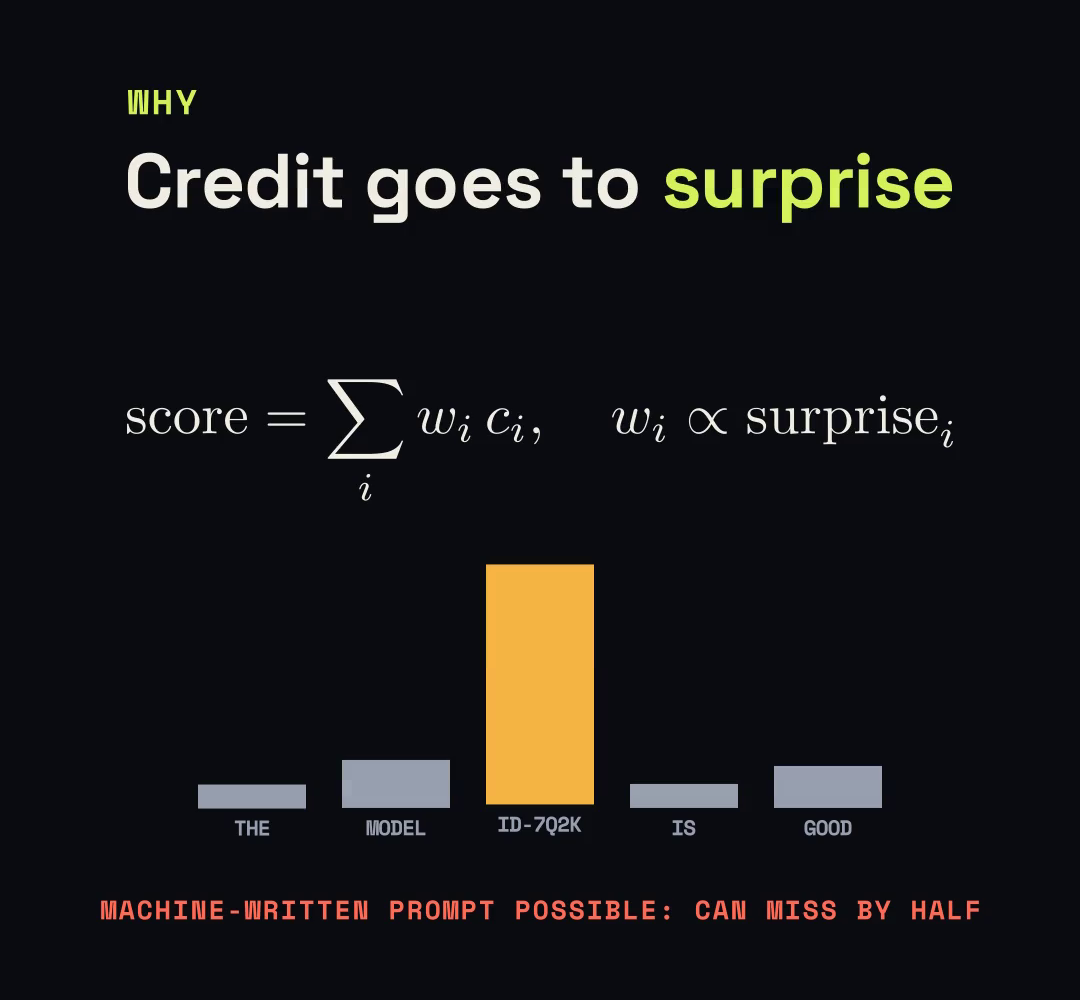
<p><img src="/lucidum/assets/posts/2026-10-16-ai-authorship/ledger.png" alt="A bar chart of per-word credit in which an ordinary word gets a small bar and a random ID string gets a very tall one, under the formula: score is a sum of word contributions weighted by surprise." />
<em>The score is a surprisal-weighted average, so rare strings soak up the credit (schematic).</em></p>

<h2 id="why-it-happens">Why it happens</h2>

<p>The authors derive an exact identity they call the credit ledger. The score is a surprisal-weighted average over the text. Rare strings, ones that would be very surprising without the context, carry big weights. If the context makes them easy to copy, they collect the credit, whatever they mean.</p>

<p>They also prove a deeper limit, a two-point bound. If the prompt itself could have been machine-written, then in the worst case every method that only looks at the transcript must miss by half of the contribution at stake.</p>

<h2 id="the-catch">The catch</h2>

<p class="catch">This is a preprint and hasn’t been peer reviewed. It’s about one family of measures, the ones based on how likely the text is given the prompt, not about every AI detector. The authors don’t say human contribution can’t be measured at all. They say likelihood scores alone can’t establish it without evidence of what the person added and how the text was produced.</p>

<p>A number that says “85% you” is only as good as what it actually measured.</p>]]></content><author><name></name></author><summary type="html"><![CDATA[As AI becomes a normal part of writing, the question shifts from “did you use AI?” to “how much of this is yours?” A new paper shows that a prominent way of answering it can be gamed with a trick: ask the AI to copy a few random codes, and the same text can score 85% human instead of 15%.]]></summary><media:thumbnail xmlns:media="http://search.yahoo.com/mrss/" url="https://sadiqebrahim.github.io/lucidum/assets/img/social.jpg" /><media:content medium="image" url="https://sadiqebrahim.github.io/lucidum/assets/img/social.jpg" xmlns:media="http://search.yahoo.com/mrss/" /></entry><entry><title type="html">The best any ride app can do is match 82%</title><link href="https://sadiqebrahim.github.io/lucidum/2026/10/16/online-matching/" rel="alternate" type="text/html" title="The best any ride app can do is match 82%" /><published>2026-10-16T23:21:00+05:30</published><updated>2026-10-16T23:21:00+05:30</updated><id>https://sadiqebrahim.github.io/lucidum/2026/10/16/online-matching</id><content type="html" xml:base="https://sadiqebrahim.github.io/lucidum/2026/10/16/online-matching/"><![CDATA[<p>Open a ride app and requests appear one at a time. Each has to be matched to a driver on the spot, before anyone knows who will ask next. A <a href="https://arxiv.org/abs/2610.19866">new paper</a> settles exactly how well any such on-the-spot strategy can ever do: about <mark>82% of the hindsight optimum</mark>.</p>

<h2 id="matching-without-seeing-the-future">Matching without seeing the future</h2>

<p>The problem is called online matching. Demands arrive over time, each must be paired immediately and irrevocably, and you’re scored against the best matching you could have made with hindsight, knowing every arrival in advance. Ride apps are our illustration; the same structure appears in delivery, ad slots and any marketplace that pairs people as they show up.</p>

<p>This paper studies the unweighted version, where every successful match counts the same, with a known arrival law: you don’t know who’s coming next, but you do know the statistics of how arrivals happen.</p>

<h2 id="the-ceiling">The ceiling</h2>

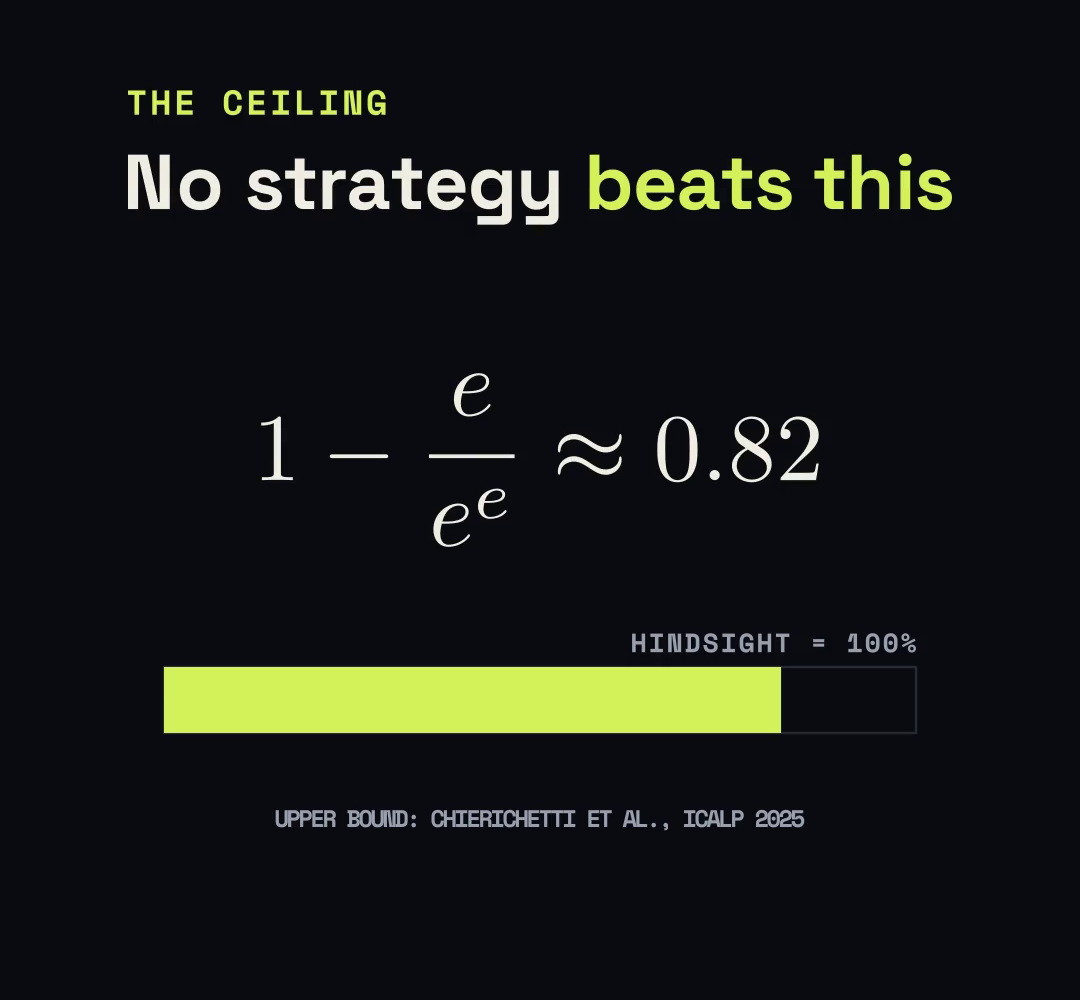
<p>An earlier paper (Chierichetti, Giacchini, Panconesi and Vattani, ICALP 2025) proved that no online strategy can beat a competitive ratio of</p>

<p>1 − e/eᵉ ≈ 0.8206</p>

<p>for Poisson arrivals. That is the ceiling. What was missing was a strategy that actually reaches it.</p>

<p><img src="/lucidum/assets/posts/2026-10-16-online-matching/ceiling.png" alt="The formula 1 minus e over e to the e, approximately 0.82, above a bar filled to 82% of the hindsight score." />
<em>No on-the-spot strategy can beat about 82% of hindsight. The new paper shows one that gets there.</em></p>

<h2 id="reaching-it">Reaching it</h2>

<p>Paul Dütting, Michal Feldman and Mathieu Molina close the gap. For Poisson arrivals their method achieves exactly 1 − e/eᵉ, so the bound is now tight: about 82% is both possible and the best possible. For a fixed number n of independent arrivals, they get the same guarantee up to a small additive loss that shrinks like 1/√n.</p>

<p>The key idea is a surprising equivalence. Matching Poisson arrivals turns out to be exactly the same problem as scheduling jobs whose timing is exponentially random, preserving both how the online strategy performs and what the hindsight optimum is. They design an optimal policy for the scheduling version and carry its guarantee back to matching.</p>

<p>They also show that if the arrival law is unknown, the best achievable ratio is strictly lower than 1 − e/eᵉ. Knowing the pattern of arrivals is worth something real.</p>

<h2 id="the-catch">The catch</h2>

<p class="catch">This is a preprint and hasn’t been peer reviewed. The result is for unweighted matching (every match counts equally) and a known arrival law; real platforms weigh matches by distance, price and time. The 82% is a worst-case-style guarantee against hindsight, not a measured success rate for any real app.</p>

<p>Matching on the spot has a hard ceiling, and now we know a strategy that hits it.</p>]]></content><author><name></name></author><summary type="html"><![CDATA[Open a ride app and requests appear one at a time. Each has to be matched to a driver on the spot, before anyone knows who will ask next. A new paper settles exactly how well any such on-the-spot strategy can ever do: about 82% of the hindsight optimum.]]></summary><media:thumbnail xmlns:media="http://search.yahoo.com/mrss/" url="https://sadiqebrahim.github.io/lucidum/assets/img/social.jpg" /><media:content medium="image" url="https://sadiqebrahim.github.io/lucidum/assets/img/social.jpg" xmlns:media="http://search.yahoo.com/mrss/" /></entry><entry><title type="html">Pull rubber slowly and the tear runs sideways</title><link href="https://sadiqebrahim.github.io/lucidum/2026/10/16/rubber-tear/" rel="alternate" type="text/html" title="Pull rubber slowly and the tear runs sideways" /><published>2026-10-16T23:20:00+05:30</published><updated>2026-10-16T23:20:00+05:30</updated><id>https://sadiqebrahim.github.io/lucidum/2026/10/16/rubber-tear</id><content type="html" xml:base="https://sadiqebrahim.github.io/lucidum/2026/10/16/rubber-tear/"><![CDATA[<p>Tear a strip of rubber quickly and the crack usually runs straight across. A <a href="https://arxiv.org/abs/2610.20275">new study</a> finds that in one common kind of rubber, pulling slowly does something unexpected: the crack veers off sideways, and the material gives way far more easily.</p>

<h2 id="the-usual-picture-fast-cracks-go-wild">The usual picture: fast cracks go wild</h2>

<p>In most solids, cracks only become unstable when they move fast. A fast-running crack can wobble, branch or curve. A slow one tends to follow the straightest path. That’s the textbook intuition.</p>

<h2 id="the-experiment">The experiment</h2>

<p>Physicists G. Pallares, O. Ramos and L. Vanel tested nanoparticle-filled elastomers: rubber packed with tiny filler particles. They pulled samples apart at a range of speeds and tracked the path the crack took.</p>

<h2 id="slower-means-more-sideways">Slower means more sideways</h2>

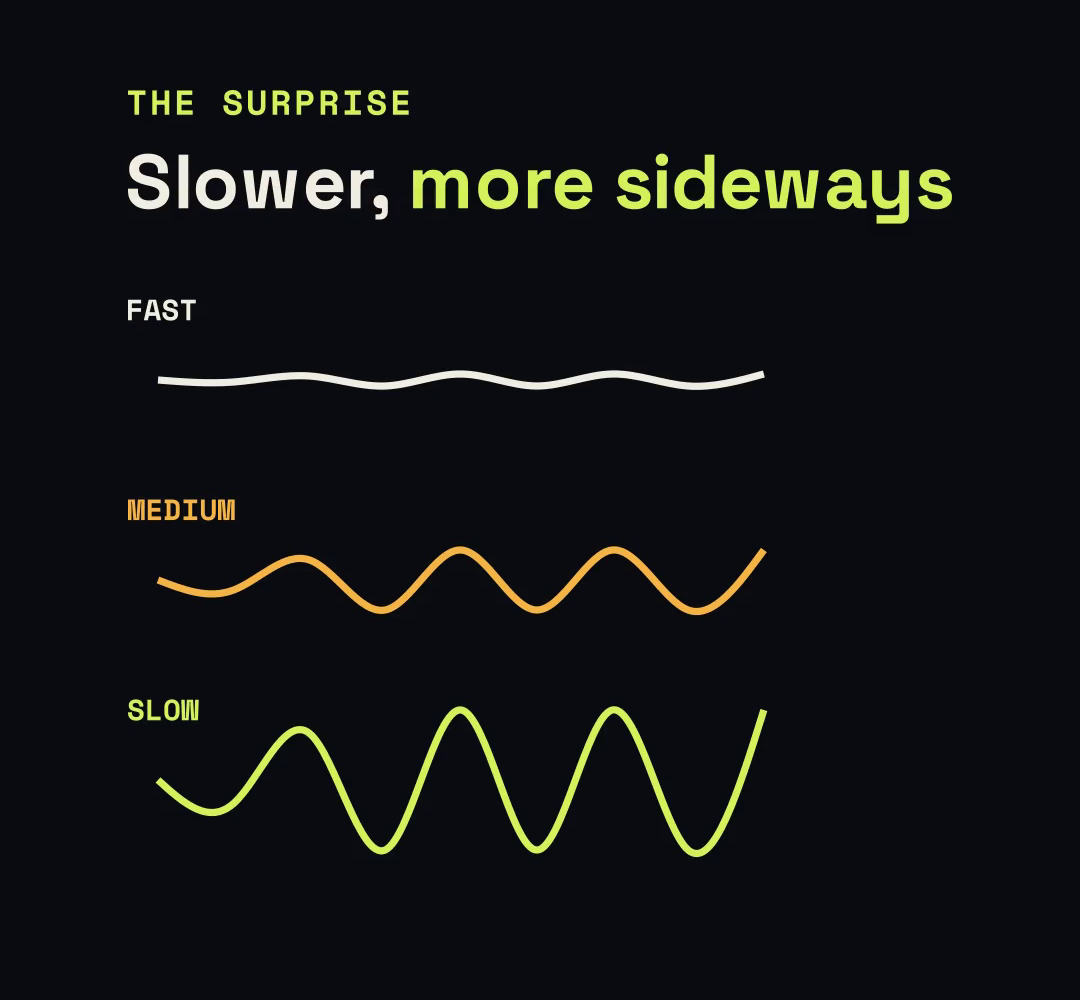
<p>They found a sideways crack-path instability that behaves the opposite way to the textbook picture. It is <mark>amplified as the pulling speed decreases</mark> and nearly vanishes when the rubber is pulled fast.</p>

<p><img src="/lucidum/assets/posts/2026-10-16-rubber-tear/surprise.png" alt="Three cracks: at fast pulling the crack is nearly straight, at medium speed it wobbles, at slow speed it swings widely from side to side." />
<em>The slower the pull, the further the crack swings (schematic).</em></p>

<p>The swing follows two simple relations:</p>

<ul>
  <li>its size <strong>falls with the logarithm of the pulling speed</strong>, so every tenfold slowdown adds a similar amount of swing;</li>
  <li>its size <strong>grows with the square root of the filler fraction</strong>, the share of the rubber taken up by the particles.</li>
</ul>

<h2 id="why-it-matters-much-easier-to-break">Why it matters: much easier to break</h2>

<p>The large sideways deviations appeared at low average crack speeds and came with effective fracture energies up to two orders of magnitude lower. In other words, when the crack wanders, the rubber can break with up to a hundred times less energy than you’d expect.</p>

<p>The authors say this fits “subcritical” rupture: the crack creeps forward in small steps under a load that wouldn’t break the material in one go. They suggest the size of the swing is limited by the rubber’s elasto-adhesive length, a scale set by how sticky and how stretchy the material is.</p>

<p>Filled rubbers are everywhere, so a failure mode that gets worse under slow loading is worth knowing about for anything that is stretched gently over a long time.</p>

<h2 id="the-catch">The catch</h2>

<p class="catch">This is a preprint and hasn’t been peer reviewed. The result is for nanoparticle-filled elastomers; the abstract doesn’t claim it holds for unfilled rubber or other materials. The mechanism (subcritical rupture capped by the elasto-adhesive length) is the authors’ interpretation of the data, described as consistent with it rather than proven.</p>

<p>Sometimes the slow, gentle pull is the one that does the real damage.</p>]]></content><author><name></name></author><summary type="html"><![CDATA[Tear a strip of rubber quickly and the crack usually runs straight across. A new study finds that in one common kind of rubber, pulling slowly does something unexpected: the crack veers off sideways, and the material gives way far more easily.]]></summary><media:thumbnail xmlns:media="http://search.yahoo.com/mrss/" url="https://sadiqebrahim.github.io/lucidum/assets/img/social.jpg" /><media:content medium="image" url="https://sadiqebrahim.github.io/lucidum/assets/img/social.jpg" xmlns:media="http://search.yahoo.com/mrss/" /></entry><entry><title type="html">An AI can hide a skill that no safety test will find</title><link href="https://sadiqebrahim.github.io/lucidum/2026/10/13/hidden-skill/" rel="alternate" type="text/html" title="An AI can hide a skill that no safety test will find" /><published>2026-10-13T23:53:00+05:30</published><updated>2026-10-13T23:53:00+05:30</updated><id>https://sadiqebrahim.github.io/lucidum/2026/10/13/hidden-skill</id><content type="html" xml:base="https://sadiqebrahim.github.io/lucidum/2026/10/13/hidden-skill/"><![CDATA[<p>Before an AI model is released, safety testers try to find every dangerous thing it can do. A <a href="https://arxiv.org/abs/2610.13928">new paper</a>, accepted at the NeurIPS 2026 conference, shows that a model can be built to carry a skill those tests will not find, even when testers can see every weight.</p>

<h2 id="the-assumption-behind-safety-testing">The assumption behind safety testing</h2>

<p>Capability evaluations are a central part of how labs and governments judge AI risk. Testers prompt a model, fine-tune it, and probe its internals, looking for dangerous abilities. The whole approach rests on one assumption: if a capability is in there, enough effort can draw it out.</p>

<p>Andis Draguns, Sumeet Ramesh Motwani, Raymond Douglas and Christian Schroeder de Witt show that the assumption fails when someone is deliberately trying to hide things.</p>

<h2 id="a-network-inside-the-network">A network inside the network</h2>

<p>Their construction is a kind of backdoor. Inside the weights of an ordinary host model they embed a second neural network, encrypted. On normal inputs, the encrypted part does nothing visible. Only when a secret trigger appears does it get decrypted and run.</p>

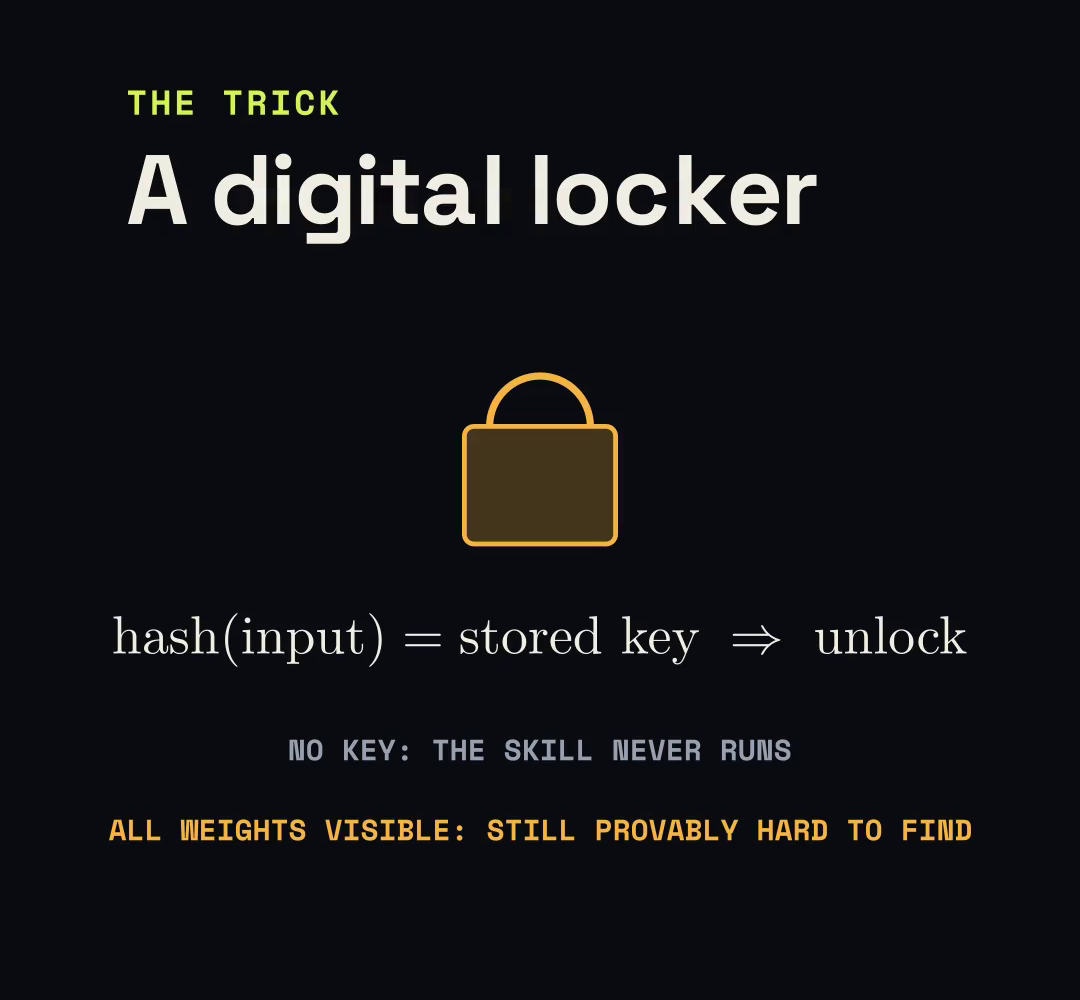
<p>The lock is a cryptographic tool called a digital locker. Think of a box that opens only if you supply the right key, checked in a way that reveals nothing about the key or the contents to anyone without it. Without the trigger, the hidden circuit never runs. Even with full access to every weight, it stays <mark>provably hard to elicit or interpret</mark>, as long as the underlying cryptographic assumptions hold. Earlier work could hide fixed strings this way; this paper extends it to arbitrary computations.</p>

<p><img src="/lucidum/assets/posts/2026-10-13-hidden-skill/locker.png" alt="A padlock above the rule: if the hash of the input equals the stored key, unlock. With no key the skill never runs; even with all weights visible it stays hard to find." />
<em>A digital locker: the hidden network runs only when the input matches a secret key.</em></p>

<h2 id="putting-it-to-the-test">Putting it to the test</h2>

<p>The authors built a proof of concept in PyTorch, using a small chemical-reaction prediction task as a stand-in for the kind of dangerous chemical, biological, radiological or nuclear (CBRN) knowledge evaluators look for. They then tried to bring the hidden skill out with fine-tuning, weight noising, gradient-based searches for the trigger, and latent adversarial training. The construction resisted all of them.</p>

<p>They have released their models so others can work on better defences.</p>

<h2 id="why-it-matters">Why it matters</h2>

<p>The result sets a hard limit on what elicitation-based audits can prove. Passing a capability evaluation shows that testers didn’t find a dangerous skill. Against a determined adversary who built the model, it can’t show that no such skill exists. That points towards other kinds of assurance, such as knowing who trained a model and how, rather than relying on testing the finished weights alone.</p>

<h2 id="the-catch">The catch</h2>

<p class="catch">This is a deliberate construction by an attacker, not evidence that today’s models hide anything. The demonstration uses a small proxy task, not real hazardous capabilities. The guarantees rest on standard cryptographic assumptions. The paper has been accepted at NeurIPS 2026, a peer-reviewed conference.</p>

<p>A model that passes every test has passed every test, and that isn’t quite the same thing as being safe.</p>]]></content><author><name></name></author><summary type="html"><![CDATA[Before an AI model is released, safety testers try to find every dangerous thing it can do. A new paper, accepted at the NeurIPS 2026 conference, shows that a model can be built to carry a skill those tests will not find, even when testers can see every weight.]]></summary><media:thumbnail xmlns:media="http://search.yahoo.com/mrss/" url="https://sadiqebrahim.github.io/lucidum/assets/img/social.jpg" /><media:content medium="image" url="https://sadiqebrahim.github.io/lucidum/assets/img/social.jpg" xmlns:media="http://search.yahoo.com/mrss/" /></entry><entry><title type="html">Change one number in quantum physics, and looking freezes a gas</title><link href="https://sadiqebrahim.github.io/lucidum/2026/10/13/warped-born/" rel="alternate" type="text/html" title="Change one number in quantum physics, and looking freezes a gas" /><published>2026-10-13T23:52:00+05:30</published><updated>2026-10-13T23:52:00+05:30</updated><id>https://sadiqebrahim.github.io/lucidum/2026/10/13/warped-born</id><content type="html" xml:base="https://sadiqebrahim.github.io/lucidum/2026/10/13/warped-born/"><![CDATA[<p>Quantum mechanics is famously delicate: change almost any part of it and the predictions go haywire. A <a href="https://arxiv.org/abs/2610.13936">new paper</a> by physicist Olumakinde Ogunnaike tests one of its most basic rules, and finds that a small change would turn the simple act of looking into something like Maxwell’s demon.</p>

<h2 id="the-rule-being-changed">The rule being changed</h2>

<p>In quantum theory a system is described by a wavefunction ψ. The Born rule says how that turns into the probabilities we see: the chance of a measurement outcome m is the squared size of the matching part of the wave,</p>

<p>p(m) ∝ ‖P_m ψ‖².</p>

<p>That exponent 2 is what links the abstract wave to the statistics of experiments.</p>

<p>Ogunnaike asks what happens if the rule is warped to</p>

<p>p_b(m) ∝ ‖P_m ψ‖^(2b),</p>

<p>so that ordinary quantum mechanics is b = 1.</p>

<h2 id="watching-a-gas">Watching a gas</h2>

<p>The paper looks at systems where the number of particles is conserved, such as a gas of particles in a row, which evolve between repeated local measurements of where the particles are. With the warped rule, some measurement histories become more likely than they should be, and the direction of that bias depends on whether b is above or below 1.</p>

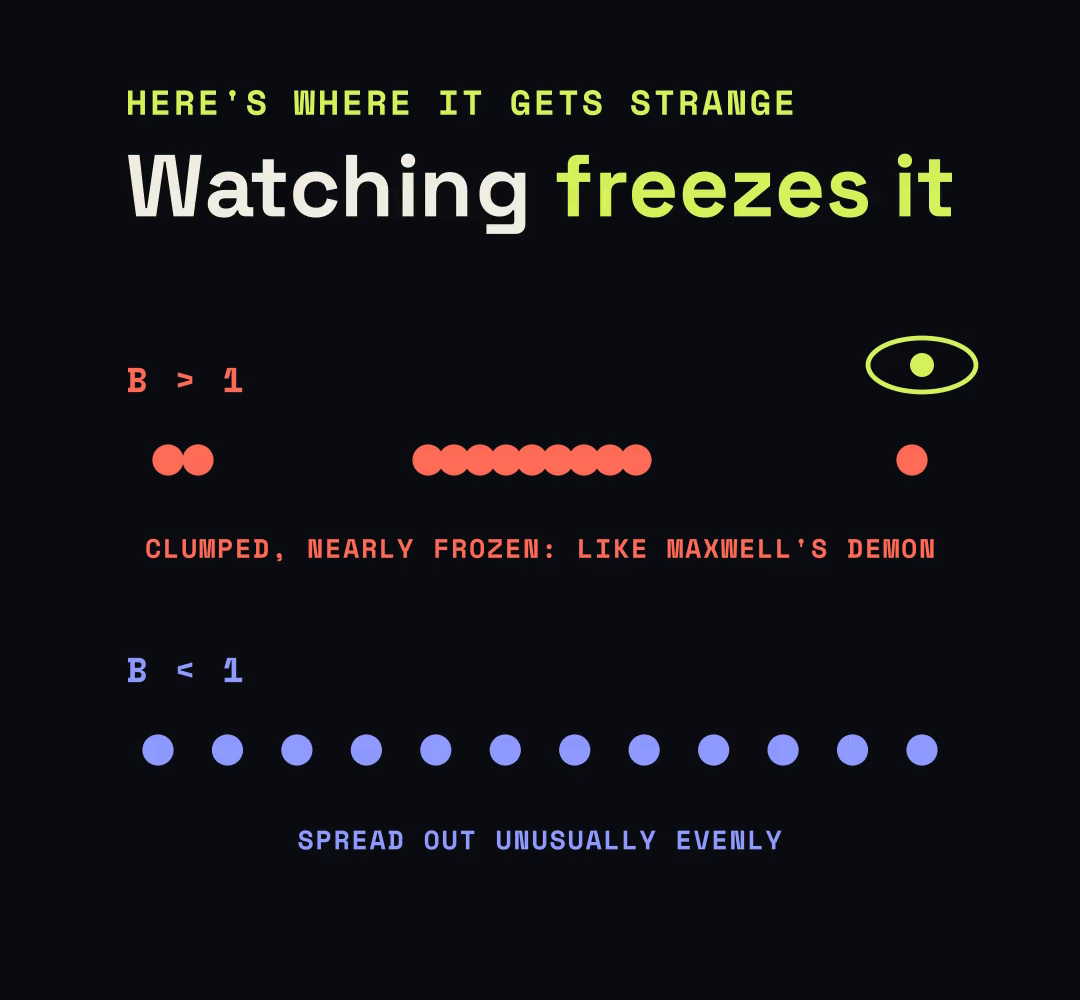
<ul>
  <li><strong>b &gt; 1:</strong> the gas tends to collect into <mark>nearly frozen configurations</mark>, clumps that stop moving. Observation alone seems to pull entropy out of a closed system, much like Maxwell’s demon, the imaginary creature that sorts molecules to reduce disorder.</li>
  <li><strong>b &lt; 1:</strong> the bias reverses. Long-wavelength fluctuations get scoured out and the gas becomes hyperuniform, spread out more evenly than a random gas would be.</li>
</ul>

<p><img src="/lucidum/assets/posts/2026-10-13-warped-born/demon.png" alt="Two rows of particles under repeated observation: for b greater than one they clump together; for b less than one they spread out evenly." />
<em>Under a warped Born rule, watching makes a gas clump (b &gt; 1) or spread unusually evenly (b &lt; 1). Schematic.</em></p>

<p>Both phases are derived analytically for a one-dimensional quantum gas under a particular measurement scheme. They are then checked numerically for more general measurement circuits using matrix-product-state simulations.</p>

<h2 id="why-it-matters">Why it matters</h2>

<p>There are two reasons. First, it’s another demonstration of how rigid quantum theory is. Nudge the Born rule even slightly and you get wildly unphysical behaviour, such as an observer that lowers entropy just by looking. That is a kind of argument for why the rule is what it is.</p>

<p>Second, the warped rule isn’t purely hypothetical as a calculation tool. The “replica trick”, a widely used technique in physics, effectively works with powers like this. The paper argues the bias shows up there too, implying qualitative differences between calculations done at a finite number of replicas and those taken to the replica limit.</p>

<h2 id="the-catch">The catch</h2>

<p class="catch">This is a thought experiment about a hypothetical rule. Nothing in the paper suggests nature actually departs from the Born rule. The analytic results cover one measurement scheme in one dimension, and the broader claims rest on simulations. It’s also a preprint that hasn’t been peer reviewed.</p>

<p>Square the wave and the world behaves. Change the square, and even looking starts to change things.</p>]]></content><author><name></name></author><summary type="html"><![CDATA[Quantum mechanics is famously delicate: change almost any part of it and the predictions go haywire. A new paper by physicist Olumakinde Ogunnaike tests one of its most basic rules, and finds that a small change would turn the simple act of looking into something like Maxwell’s demon.]]></summary><media:thumbnail xmlns:media="http://search.yahoo.com/mrss/" url="https://sadiqebrahim.github.io/lucidum/assets/img/social.jpg" /><media:content medium="image" url="https://sadiqebrahim.github.io/lucidum/assets/img/social.jpg" xmlns:media="http://search.yahoo.com/mrss/" /></entry><entry><title type="html">Debunking a fake post can help it spread</title><link href="https://sadiqebrahim.github.io/lucidum/2026/10/13/debunk-spread/" rel="alternate" type="text/html" title="Debunking a fake post can help it spread" /><published>2026-10-13T23:51:00+05:30</published><updated>2026-10-13T23:51:00+05:30</updated><id>https://sadiqebrahim.github.io/lucidum/2026/10/13/debunk-spread</id><content type="html" xml:base="https://sadiqebrahim.github.io/lucidum/2026/10/13/debunk-spread/"><![CDATA[<p>You see a silly fake post and reply “this is false”. It feels like the responsible thing to do. A <a href="https://arxiv.org/abs/2610.13839">new model</a> of how disinformation spreads suggests that for some fakes, that reply is exactly what carries them further.</p>

<h2 id="three-things-ordinary-cascade-models-miss">Three things ordinary cascade models miss</h2>

<p>Researchers have long modelled how posts cascade through social networks, borrowing ideas from epidemics. Guillermo Romero Moreno, Valentin Robu and Han La Poutré argue that disinformation has three features those models usually leave out:</p>

<ul>
  <li><strong>It provokes debunking.</strong> People don’t just share or ignore a fake; they also reply to correct it.</li>
  <li><strong>Networks are uneven.</strong> A few accounts have enormous numbers of connections and most have few.</li>
  <li><strong>Attention is limited.</strong> Users only see so much, though recommendation algorithms can partly change what they see.</li>
</ul>

<p>They built a model with all three and studied it with Monte Carlo simulations and mean-field mathematics, on random networks and on a real Twitter network.</p>

<h2 id="debunking-cuts-both-ways">Debunking cuts both ways</h2>

<p>For appealing fakes, the kind many people would happily share, debunking works as intended: corrections reduce how far the item travels.</p>

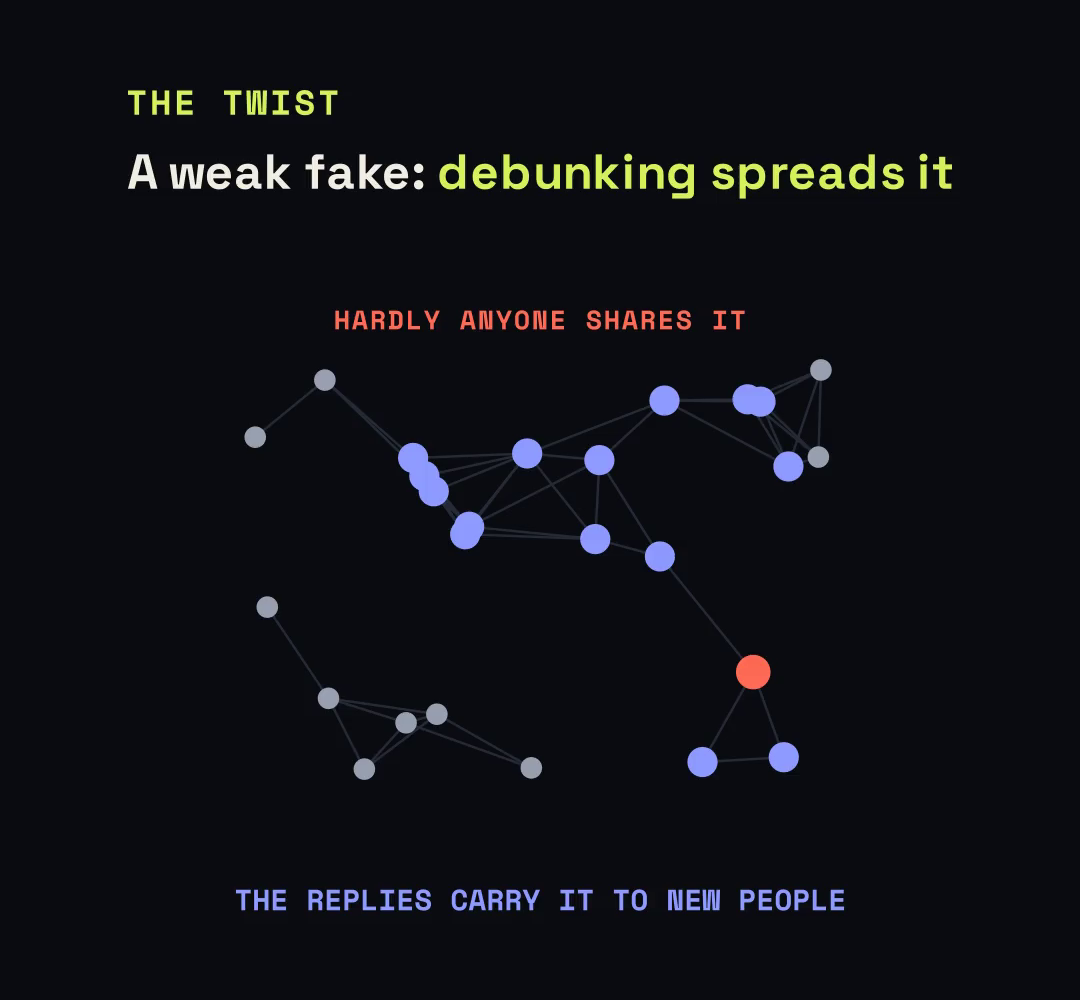
<p>For unappealing fakes, it’s the opposite. An item hardly anyone would share should fizzle out on its own. But debunking replies are themselves activity, and in the model they <mark>let unappealing items reach audiences they would not otherwise reach</mark>.</p>

<p><img src="/lucidum/assets/posts/2026-10-13-debunk-spread/spread.png" alt="A network where one weak fake starts at a single node and the debunking replies light up a growing set of other nodes." />
<em>A weak fake that hardly anyone shares, carried outwards by the replies debunking it (schematic).</em></p>

<h2 id="easy-to-ignite-hard-to-saturate">Easy to ignite, hard to saturate</h2>

<p>The model also shows what uneven networks do. When a few accounts are hugely connected, cascades trigger at much lower appeal, because one hub can expose a fake to many people at once. But the same structure limits final reach, because most accounts sit on the edges with few connections. The authors sum it up as “easy to ignite yet hard to saturate”.</p>

<p>Limited attention cancels those network effects: if people only see a slice of what reaches them, a hub’s reach counts for less. Recommendation algorithms that decide what people see may restore the effects.</p>

<h2 id="why-it-matters">Why it matters</h2>

<p>Platforms, fact-checkers and ordinary users all face the same question: should this be corrected in public? The model suggests the answer depends on the item. For a fake that is already spreading, correction helps. For one that is going nowhere, a loud public correction may be what gives it an audience.</p>

<h2 id="the-catch">The catch</h2>

<p class="catch">This is a simulation model, not a measurement of real users, and it’s a preprint that hasn’t been peer reviewed (it has been submitted to the Complex Networks 2026 conference). Its results depend on how appeal, debunking and attention are modelled. Real platforms also have features the model may not capture, such as quote-posts and different ways of showing replies.</p>

<p>Before you reply to a fake that’s going nowhere, it’s worth asking who your correction will show it to.</p>]]></content><author><name></name></author><summary type="html"><![CDATA[You see a silly fake post and reply “this is false”. It feels like the responsible thing to do. A new model of how disinformation spreads suggests that for some fakes, that reply is exactly what carries them further.]]></summary><media:thumbnail xmlns:media="http://search.yahoo.com/mrss/" url="https://sadiqebrahim.github.io/lucidum/assets/img/social.jpg" /><media:content medium="image" url="https://sadiqebrahim.github.io/lucidum/assets/img/social.jpg" xmlns:media="http://search.yahoo.com/mrss/" /></entry><entry><title type="html">Why a fixed money budget protects you from price hikes</title><link href="https://sadiqebrahim.github.io/lucidum/2026/10/13/mental-budget/" rel="alternate" type="text/html" title="Why a fixed money budget protects you from price hikes" /><published>2026-10-13T23:50:00+05:30</published><updated>2026-10-13T23:50:00+05:30</updated><id>https://sadiqebrahim.github.io/lucidum/2026/10/13/mental-budget</id><content type="html" xml:base="https://sadiqebrahim.github.io/lucidum/2026/10/13/mental-budget/"><![CDATA[<p>Some people budget their coffee in money: “2,000 a month, whatever happens.” Others budget in cups: “thirty a month, no matter what.” A <a href="https://arxiv.org/abs/2610.12587">new paper</a> argues the first habit does something the second doesn’t: it quietly takes away a seller’s power to raise prices on you.</p>

<h2 id="money-jars-in-your-head">Money jars in your head</h2>

<p>Economists call it mental accounting: keeping separate pots in your head for coffee, clothes, eating out and so on, and not letting money flow freely between them. Strictly speaking it looks irrational, since money is money. The usual explanation is self-control. Jars stop you overspending on things you’ll regret.</p>

<p>Jarrod Burgh, Emerson Melo and Matthew Shum offer a third explanation, separate from self-control and from the standard theory of two-stage budgeting: protection against a seller’s market power.</p>

<h2 id="the-arithmetic-of-a-fixed-budget">The arithmetic of a fixed budget</h2>

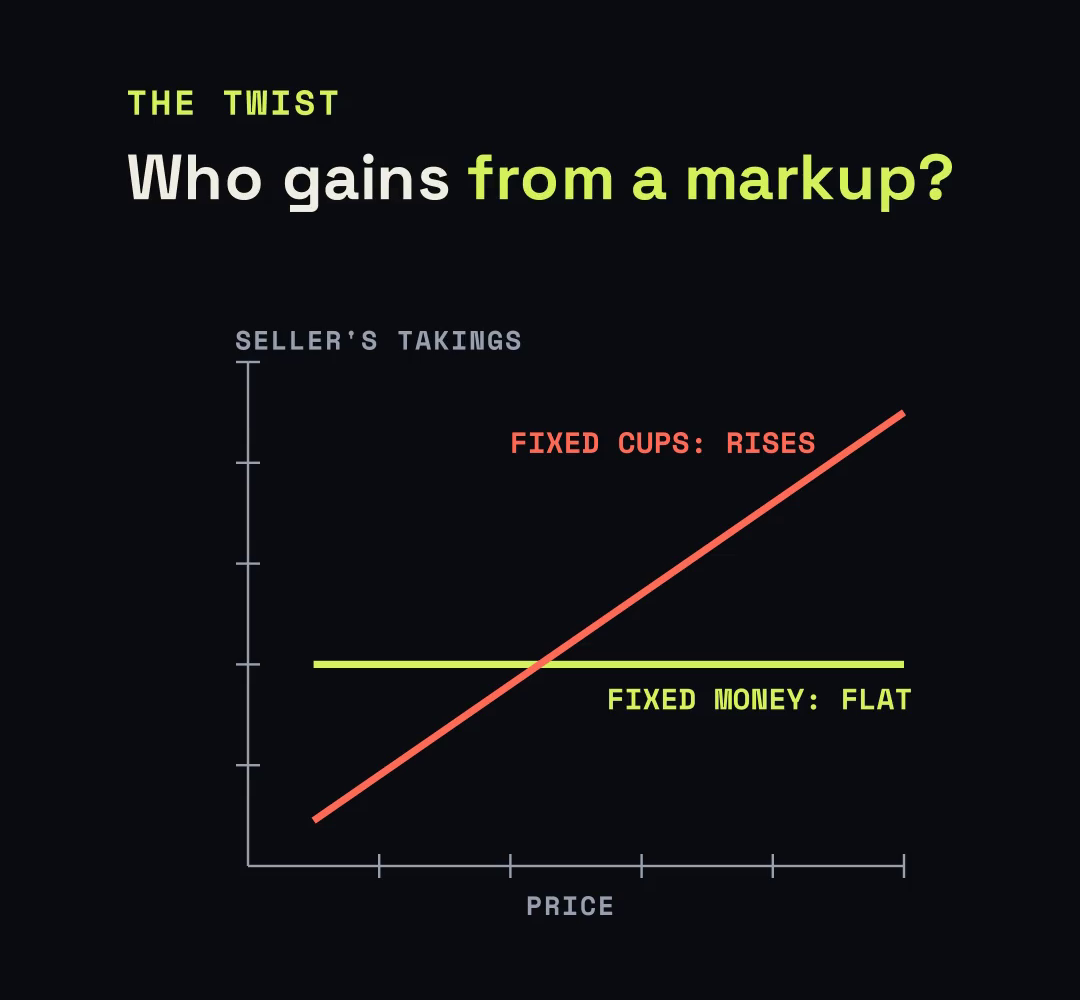
<p>A seller’s takings are simply price times quantity. Suppose you commit to spending a fixed amount B on coffee each month. Then price × cups = B, whatever the price. If the café raises its price, you buy fewer cups, and its takings stay exactly B.</p>

<p>Economists call this unit-elastic demand. A seller facing it gains nothing by restricting quantity and pushing the price up, because revenue doesn’t move.</p>

<p><img src="/lucidum/assets/posts/2026-10-13-mental-budget/takings.png" alt="Seller's takings against price. With a fixed money budget the line is flat; with a fixed number of cups it rises with the price." />
<em>Fixed money: the seller’s takings stay flat as the price rises. Fixed cups: they rise with it (schematic).</em></p>

<p>Now suppose you insist on a fixed quantity instead: thirty cups, no matter what. Your demand is perfectly inelastic. Every price rise goes straight into the seller’s pocket, and a monopolist can exploit that as far as you’ll let it.</p>

<h2 id="what-the-paper-proves">What the paper proves</h2>

<p>The authors characterise which spending commitments remove a seller’s incentive to mark up prices, and show that <mark>the fixed money budget is the least restrictive of them</mark>. It is the loosest rule that still does the job.</p>

<p>They also show that what matters is rigidity, not the separate jars themselves. A consumer who re-optimises their category budget whenever prices change is protected from market power only if the categories are substitutes for one another. A rigid budget, one that doesn’t move, protects them in every case. On this reading, mental accounting is a commitment device against markups.</p>

<h2 id="why-it-matters">Why it matters</h2>

<p>Behavioural economics often treats mental accounting as a bias to be corrected. This paper gives it a rational job: if you face sellers with pricing power, refusing to let your spending in a category rise with the price disciplines them. It also gives a concrete rule for anyone with a budget: set categories in money, not in quantities, and don’t renegotiate them every time the price moves.</p>

<h2 id="the-catch">The catch</h2>

<p class="catch">This is a preprint and hasn’t been peer reviewed. It’s a theory paper, not a field study, so it doesn’t measure how much real shoppers save. The argument is about sellers with market power, such as a monopolist. It doesn’t claim that fixed budgets lower prices in competitive markets, where sellers can’t raise prices freely anyway.</p>

<p>The coffee jar in your head might be doing more than keeping you disciplined: it may be keeping the café honest too.</p>]]></content><author><name></name></author><summary type="html"><![CDATA[Some people budget their coffee in money: “2,000 a month, whatever happens.” Others budget in cups: “thirty a month, no matter what.” A new paper argues the first habit does something the second doesn’t: it quietly takes away a seller’s power to raise prices on you.]]></summary><media:thumbnail xmlns:media="http://search.yahoo.com/mrss/" url="https://sadiqebrahim.github.io/lucidum/assets/img/social.jpg" /><media:content medium="image" url="https://sadiqebrahim.github.io/lucidum/assets/img/social.jpg" xmlns:media="http://search.yahoo.com/mrss/" /></entry><entry><title type="html">One car with a big gap could stop the jam</title><link href="https://sadiqebrahim.github.io/lucidum/2026/10/12/traffic-buffer/" rel="alternate" type="text/html" title="One car with a big gap could stop the jam" /><published>2026-10-12T10:08:00+05:30</published><updated>2026-10-12T10:08:00+05:30</updated><id>https://sadiqebrahim.github.io/lucidum/2026/10/12/traffic-buffer</id><content type="html" xml:base="https://sadiqebrahim.github.io/lucidum/2026/10/12/traffic-buffer/"><![CDATA[<p>You’ve probably crawled through a traffic jam that had no cause: no crash, no roadworks, no lane closure. A <a href="https://arxiv.org/abs/2610.11557">new paper</a> proves that if cars could take on different roles, one car keeping an unusually big gap could absorb that kind of jam for everyone behind it.</p>

<h2 id="jams-that-come-from-nowhere">Jams that come from nowhere</h2>

<p>These are stop-and-go waves. One driver taps the brakes. The driver behind reacts a moment later and brakes slightly harder, the next harder again, and the slowdown grows as it travels backwards through the traffic. Eventually somebody stops completely, though nothing was ever blocking the road. The waves waste fuel, raise crash risk and cut how many cars a road can carry.</p>

<p>Traffic physicists describe this with string stability: whether a small disturbance shrinks or grows as it passes from car to car. When it grows, you get waves.</p>

<h2 id="dropping-the-everyones-the-same-assumption">Dropping the “everyone’s the same” assumption</h2>

<p>Classical traffic models assume every vehicle follows the same rule. Raphael Korbmacher and Antoine Tordeux drop that assumption. They ask: if connected vehicles could cooperate and each take a different role, what arrangement carries the most traffic while staying stable?</p>

<p>They set it up as an optimisation problem, maximising flow subject to the conditions for linear stability, and solve it analytically.</p>

<h2 id="the-answer-one-buffer-car">The answer: one buffer car</h2>

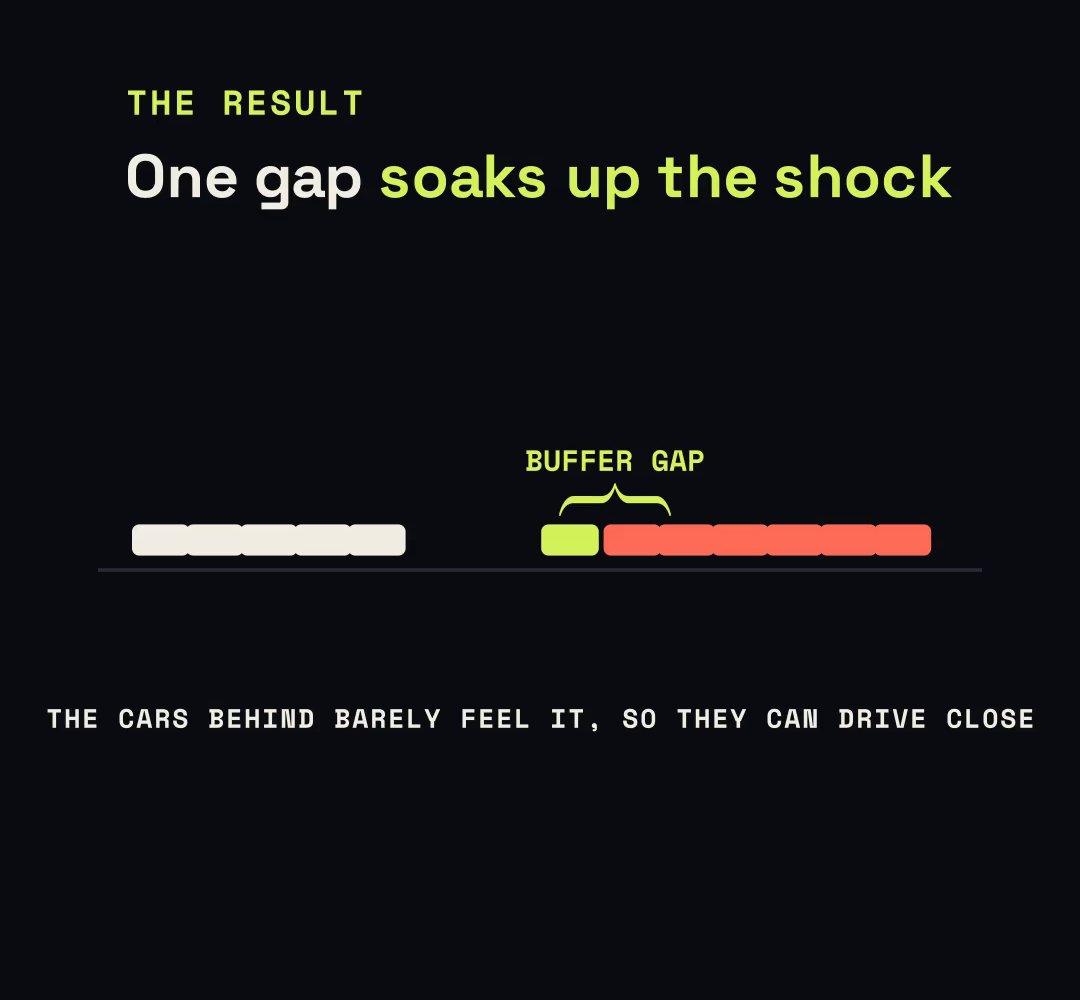
<p>The best arrangement, they prove, is for <mark>a single "buffer" vehicle to keep an enlarged gap</mark> to the car ahead, while all the others close up into a tight, high-capacity platoon. When a disturbance arrives, the buffer car has room to soften it instead of passing it on, so the platoon behind it barely feels the shock and can safely drive close.</p>

<p><img src="/lucidum/assets/posts/2026-10-12-traffic-buffer/buffer.png" alt="A line of cars with one large gap ahead of the highlighted buffer car. The cars ahead of the gap brake; the cars behind barely react." />
<em>One buffer gap absorbs the braking ahead, so the cars behind can drive close together (schematic).</em></p>

<p>It sounds backwards, since a big gap looks like wasted road. But one big gap in exchange for many small ones turns out to carry more cars than spacing everybody out evenly.</p>

<h2 id="checking-the-proof">Checking the proof</h2>

<p>The authors confirmed the result numerically in two standard car-following models, the Intelligent Driver Model and the Full Velocity Difference Model, using spectral analysis and stability-constrained flow optimisation. The buffering strategy greatly expanded the range of settings where traffic stays string-stable, and it delivered higher flow than both ordinary unbuffered traffic and “jam-absorption driving”, where individual drivers try to soak up waves on their own without coordinating.</p>

<h2 id="the-catch">The catch</h2>

<p class="catch">This is a preprint and hasn’t been peer reviewed. The result is a theory backed by simulation: it hasn’t been tried on a real road. It also assumes connected vehicles that can coordinate and be assigned roles, which describes future automated traffic far better than today’s human drivers.</p>

<p>Traffic may flow best not when every car behaves the same, but when one car is willing to hang back for everyone else.</p>]]></content><author><name></name></author><summary type="html"><![CDATA[You’ve probably crawled through a traffic jam that had no cause: no crash, no roadworks, no lane closure. A new paper proves that if cars could take on different roles, one car keeping an unusually big gap could absorb that kind of jam for everyone behind it.]]></summary><media:thumbnail xmlns:media="http://search.yahoo.com/mrss/" url="https://sadiqebrahim.github.io/lucidum/assets/img/social.jpg" /><media:content medium="image" url="https://sadiqebrahim.github.io/lucidum/assets/img/social.jpg" xmlns:media="http://search.yahoo.com/mrss/" /></entry><entry><title type="html">Two unbeatable computing speed limits, beaten</title><link href="https://sadiqebrahim.github.io/lucidum/2026/10/12/speed-limits/" rel="alternate" type="text/html" title="Two unbeatable computing speed limits, beaten" /><published>2026-10-12T10:07:00+05:30</published><updated>2026-10-12T10:07:00+05:30</updated><id>https://sadiqebrahim.github.io/lucidum/2026/10/12/speed-limits</id><content type="html" xml:base="https://sadiqebrahim.github.io/lucidum/2026/10/12/speed-limits/"><![CDATA[<p>For decades, computer scientists have treated two simple problems as having speed limits nobody could meaningfully beat, and they built a whole theory of which problems are hard on top of them. In a <a href="https://arxiv.org/abs/2610.06783">76-page preprint</a>, Josh Alman and Virginia Vassilevska Williams say they have broken both.</p>

<h2 id="two-puzzles">Two puzzles</h2>

<p><strong>3SUM.</strong> You get a list of n whole numbers. Are there three that add up to zero? The textbook method takes roughly n² steps: for every pair, you check whether the number that would complete it is in the list.</p>

<p><strong>All-pairs shortest paths (APSP).</strong> You get a map of n points with weighted roads between them. Find the shortest route between every pair. The textbook method takes roughly n³ steps.</p>

<p>Decades of work have shaved off smaller factors, such as powers of logarithms, but never a fixed power of n. That led to two working assumptions. The 3SUM hypothesis says no algorithm runs in n^(2−ε) time for any fixed ε &gt; 0. The APSP hypothesis says the same for n^(3−ε).</p>

<h2 id="why-everyone-cared">Why everyone cared</h2>

<p>These hypotheses became foundations for a field called fine-grained complexity. If you could show that a fast algorithm for problem X would also give a fast 3SUM or APSP algorithm, you had strong evidence that X was hard too. Many problems in geometry, graphs and data structures got their “probably can’t do better” labels this way.</p>

<h2 id="the-new-result">The new result</h2>

<p>Alman and Vassilevska Williams give deterministic algorithms that solve:</p>

<ul>
  <li>3SUM on n integers of polynomial size in O(n^1.9992) time;</li>
  <li>APSP on directed n-vertex graphs with polynomially bounded integer weights in O(n^2.9995) time.</li>
</ul>

<p><img src="/lucidum/assets/posts/2026-10-12-speed-limits/bounds.png" alt="3SUM goes from n squared to n to the 1.9992, and APSP from n cubed to n to the 2.9995." />
<em>The new exponents sit just below the old limits, but strictly below.</em></p>

<p>The exponents are only a hair below 2 and 3, but they are strictly below, and that is exactly what the hypotheses said couldn’t happen. Using known reductions, the authors say the result also refutes the real-valued versions of both hypotheses, the Exact Triangle hypothesis, the Zero-Weight k-Clique hypotheses and three Online Matrix–Vector conjectures, and speeds up a range of other problems.</p>

<h2 id="how-they-did-it">How they did it</h2>

<p>Everything comes from one new algorithm for a narrow kind of matrix multiplication. When one matrix is very thin, and you only need some of the entries of the product rather than all of them, they show you can compute those entries with fewer operations than it would take to write the full product down. They build it by modifying a variant of Coppersmith’s rectangular matrix-multiplication method, which rests on a ten-multiplication identity of Schönhage. Read as a graph problem, it finds triangles fast in sparse, lopsided graphs, and known reductions carry that speed-up back to 3SUM and APSP.</p>

<h2 id="the-catch">The catch</h2>

<p class="catch">This is a preprint and has not been peer reviewed. A 76-page proof will take experts time to check. The practical gain is tiny: going from n² to n^1.9992 matters for theory, not for anyone’s code today. The results also apply to whole-number inputs of bounded size, not to every version of these problems.</p>

<p>The speed-up is small, but <mark>a speed limit only has to fail once</mark>, and theorists now have to decide what fine-grained hardness should rest on instead.</p>]]></content><author><name></name></author><summary type="html"><![CDATA[For decades, computer scientists have treated two simple problems as having speed limits nobody could meaningfully beat, and they built a whole theory of which problems are hard on top of them. In a 76-page preprint, Josh Alman and Virginia Vassilevska Williams say they have broken both.]]></summary><media:thumbnail xmlns:media="http://search.yahoo.com/mrss/" url="https://sadiqebrahim.github.io/lucidum/assets/img/social.jpg" /><media:content medium="image" url="https://sadiqebrahim.github.io/lucidum/assets/img/social.jpg" xmlns:media="http://search.yahoo.com/mrss/" /></entry></feed>