
AI
The Pentagon's AI lie detector
The US Department of Defense has asked for $30.3 million over five years to build an AI-scored lie detector that can take readings without touching you, a request Congress hasn't approved yet.
The US Department of Defense wants a new kind of lie detector: one that uses AI to score the results and can take its readings from a distance, without wires, cuffs or clips. A budget request asks for $30.3 million over five years for the project, MIT Technology Review reports. The money hasn’t been approved by Congress, and the specific technology hasn’t been named.
What’s being asked for
The program is called Polygraph+ or Polygraph Next, and it would be run by the Defense Counterintelligence and Security Agency, which carries out background checks for the federal government. According to the budget document, first reported by Inside Defense, it has two parts: scoring algorithms built with AI and machine learning, and “standoff sensing”, meaning physiological readings taken without attaching anything to the person. It would be used to vet job applicants and for what the document calls insider threat detection.
There are hints of what that could look like. In 2023 the department’s Defense Innovation Unit picked two companies to build deception-detection prototypes. One says it can measure heart rate and breathing with ordinary cameras. The other’s prototype tracks head movement, facial skin temperature and pore activity.
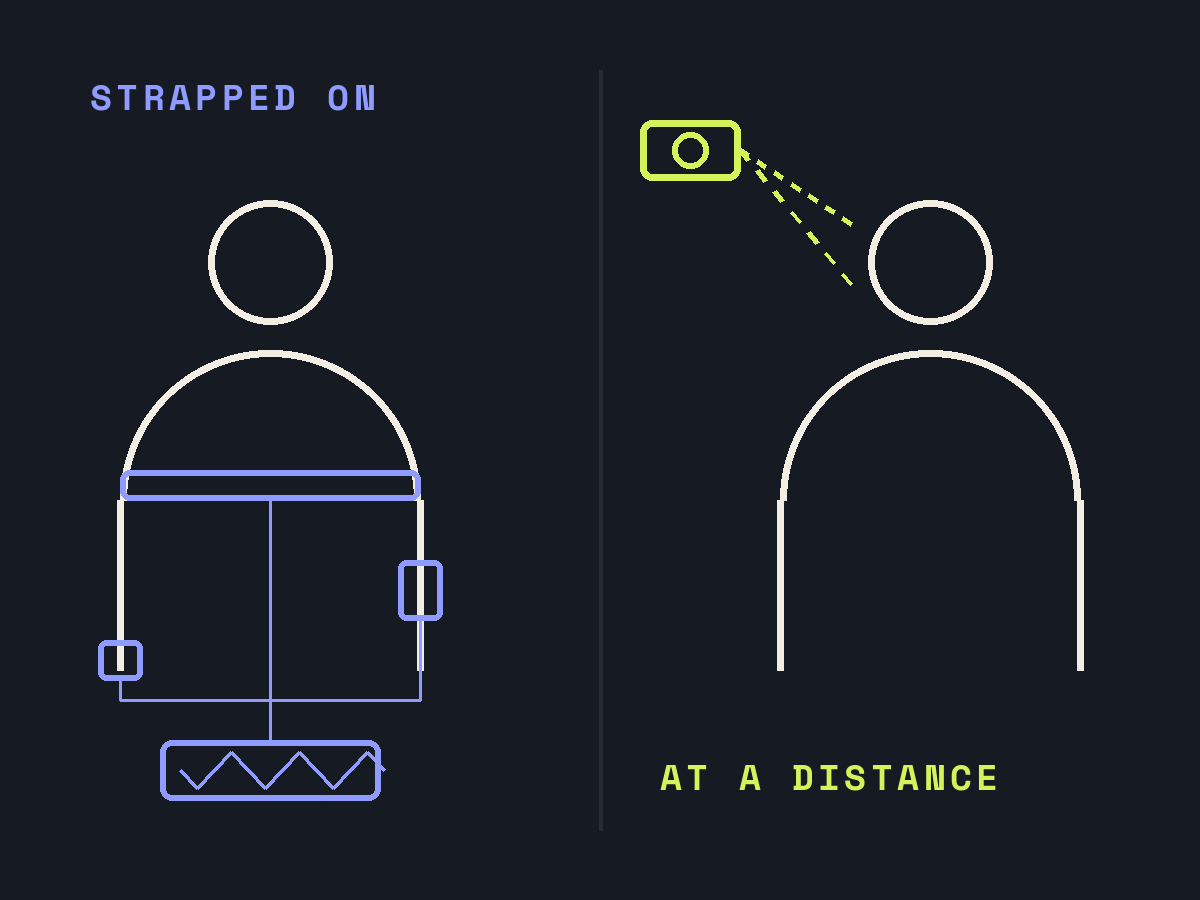 Today’s polygraph straps sensors to the body; “standoff sensing” would read the body from a distance.
How a polygraph works
The basic machine has barely changed since it was invented in the 1920s. It records blood pressure, pulse, breathing and sweating while an examiner asks two kinds of questions: easy baseline ones and the ones that actually matter. A stronger bodily reaction to the questions that matter is read as a sign of deception.
The trouble is that the machine measures stress, not honesty. Nervous truth-tellers can look guilty, and people can be trained to beat the test, for example by deliberately heightening their reaction to the baseline questions. Different examiners reading the same results can reach very different conclusions, and people from minority groups are more likely to be judged deceptive.
What the evidence says
The US government runs tens of thousands of these tests a year to screen employees, but reviews have been unkind. In 1983 Congress’s Office of Technology Assessment found very limited evidence for using polygraphs in screening, and in 2003 the National Research Council called the evidence for them “weak at best”. The results are rarely admissible in court.
Scale makes it worse. Even at the accuracy polygraph examiners’ own association claims, the 2003 report pointed out that screening would still produce many mistakes. The Department of Defense employs 2.8 million people; an imperfect test applied to all of them could wrongly accuse tens of thousands.
Could AI help?
In principle, AI could spot patterns in the data that a human examiner misses, and combining several signals (stress, mental effort and deliberate concealment) could make a score harder to game, says Sophie van der Zee, who studies deception at Erasmus University Rotterdam. But she also says there’s no single sign of lying that holds for everyone. Earlier multi-signal systems, including an EU-funded border pilot and a US border project that tracked eyes, voice and body movement, quietly faded away.
The catch
The deeper problem is that there’s nothing reliable to train an AI on. Kyri Kotsoglou of Northumbria University and Marion Oswald, a law professor who has written with him, point out that nobody knows which past polygraph results were actually right, so a machine trained on them learns the old test’s mistakes along with its patterns. Kotsoglou calls the combination of AI and the polygraph the worst of both worlds: new uncertainty stacked on a method that was never shown to work. Nothing has been built or tested in public yet, so none of this can be judged on results.
What to watch
Whether Congress funds it, and whether any test of the system’s accuracy is ever made public.
