
About Lucidum
Why we're named after a cat's eye
The tapetum lucidum gives light a second pass through the eye. We try to do the same for new research.
Point a torch into a garden at night and, if a cat is sitting there, two discs of light will look straight back at you. The cat isn’t making that light. Its eyes are returning some of yours, thanks to a thin layer of tissue that most of us have never heard of, even though it’s the reason this channel has the name it does.
A mirror behind the retina
The layer is called the tapetum lucidum. The Latin is roughly “bright tapestry” or “shining layer”, which is a fair description: it’s a reflective sheet that sits directly behind the retina, the part of the eye that turns light into signals for the brain.
In an eye without one, light that passes through the retina without being absorbed is simply lost. In a cat’s eye, that leftover light hits the tapetum and is reflected back through the retina a second time. The photoreceptors get another chance to catch it.
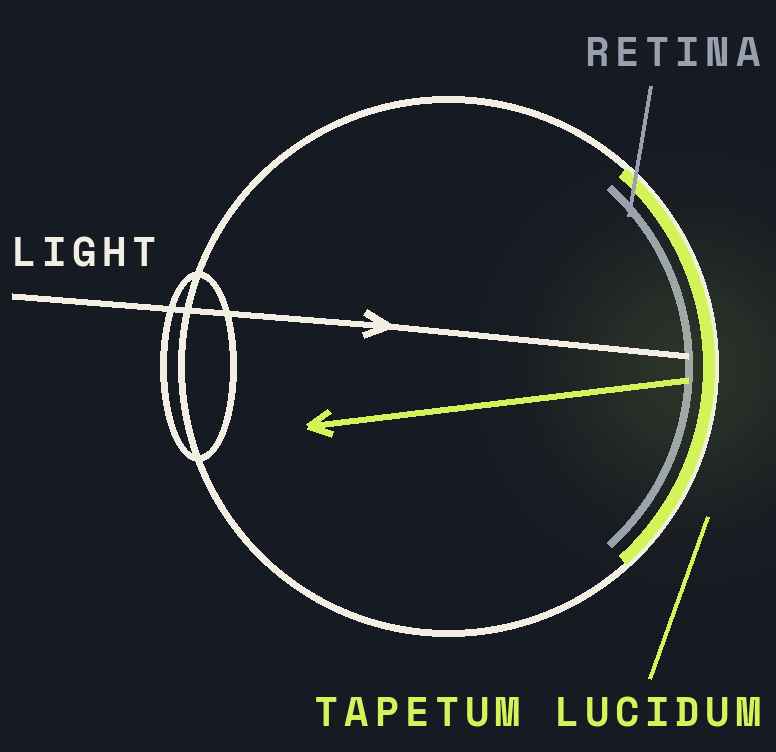 Light passes the retina once on the way in, then again after bouncing off the tapetum lucidum.
Why it matters at night
When there’s little light to begin with, catching more of it counts for a lot. That second pass is a large part of why cats and many other mostly nocturnal animals see well in dim light. Dogs, cattle, deer and sharks have one too. Humans don’t, and neither do our closest primate relatives, the monkeys and apes, which are active by day.
It still needs some light to work with. The tapetum doesn’t let an animal see in total darkness; it makes better use of whatever light there is.
The glow you see in a photo or a torch beam is the part of that reflected light that escapes back out through the pupil. Depending on the species and the angle, it can look white, blue, green or even red. Field researchers use it to spot and follow wild cats on camera traps.
The trade-off
There’s a cost. Light bouncing around inside the reflective layer scatters slightly, so the image a cat’s eye forms is a little blurrier than it would be otherwise. The eye trades some sharpness for sensitivity: more light, a bit less detail. For an animal hunting at dusk, that’s clearly a good deal.
This is the catch in the story, and we like that it has one.
Why we named ourselves after it
Lucidum covers physics, quantum computing, deep tech and new research. A lot of what gets shared about science goes through the eye only once: a headline, a striking number, a confident claim. We want to give new research a second pass. That means going back to the study, working out what was actually found and at what scale, explaining how it works in plain language, and being honest about what isn’t known yet.
In practice that means a few habits we try never to skip:
- Every claim has a source, and every article lists its sources at the end.
- Preprints are labelled. A preprint hasn’t been through peer review. When we cover one, we promise to come back to it once it has been reviewed or replicated.
- We name the scale. In cells, in mice, in forty people, in a simulation: the scale tells you how far a result reaches.
- In our own words. We paraphrase, credit the researchers, and draw our own diagrams.
Second Look, every Sunday
Once a week, we take one widely shared science headline and read the study behind it. Then we say how well the two match, using four verdicts: Clear when the headline matches the evidence, Blurry when it has the right idea but fuzzy details, Glare when it shines brighter than the evidence does, and In the dark when it’s simply too early to tell. You can find every episode on the Second Look page.
Like the layer behind a cat’s eye, the aim is not to add light that isn’t there. It’s to make better use of what’s already in front of us.