
Health
A young heart doesn't stay young
In mice, and in stored biopsies from human transplant patients, donor hearts took on the recipient's biological age within months, according to a preprint that hasn't been peer-reviewed.
One hopeful idea in aging research goes like this: swap an old part for a young one, and some of that youth might rub off on the rest of the body. A new study of heart transplants points the other way. In mice, and in stored tissue from human transplant patients, a donated heart soon took on the biological age of the body it was put into. The results are in a preprint, so they haven’t been checked by peer review yet.
What they did
Jesse Poganik and colleagues at Brigham and Women’s Hospital in Boston ran a set of transplants in mice, as MIT Technology Review reports. Instead of replacing a mouse’s heart, they added a second one in the neck. That surgery is simpler, and it leaves the original heart in place to compare against. Some middle-aged mice got hearts from young donors; some young adult mice got hearts from middle-aged donors.
To judge age, the team used three “aging clocks”, molecular tests that estimate how old a tissue behaves rather than how long it has existed. In mice that had no transplant, the clocks tracked real age well.
Between four and six months after surgery, the extra hearts had moved to match their hosts: the young hearts read older, and the older hearts read younger. The researchers also checked each mouse’s blood and other organs, including its own heart, and found no sign that the new heart had changed them, whatever the donor’s age.
In people too
Heart transplant patients have regular small biopsies after surgery, and the hospital has stored those samples for decades. Running the same clocks on them showed the same pattern: whatever the donor’s age, the new heart soon matched the recipient’s biological age. That matters, because in the hospital’s own records most recipients were about 20 years older than their donors.
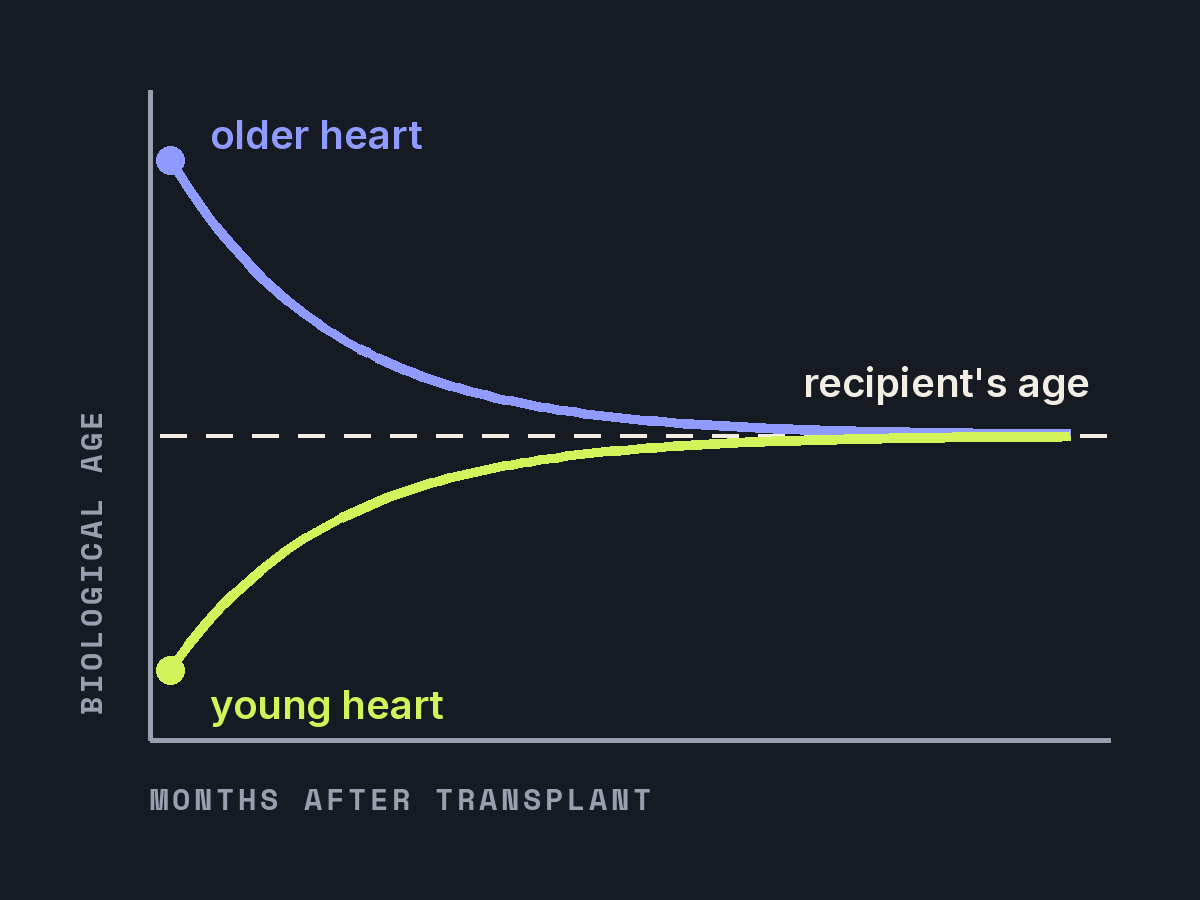 A schematic of the pattern, not the study’s data: both kinds of heart drifted toward the recipient’s biological age.
How it might work
Think of a new player joining a team: whatever pace they arrived with, within a season they’re training to the team’s schedule. The heart seems to take its cues from the body around it. Poganik puts it as the organ’s environment setting how it behaves.
Why that happens isn’t known. João Pedro de Magalhães, who studies aging at the University of Birmingham and wasn’t involved, suggests the recipient’s immune cells might be resetting the markers of aging in the new organ. Poganik offers two more possibilities: a young heart’s effect may be diluted by everything else in an older body, or one organ may simply be too little to make a difference.
Why it matters
For rejuvenation research, it’s a cold splash on the idea that young organs could make an old body younger. For transplant medicine, it could be good news. Hearts from older donors are often thrown away on the assumption they won’t work as well. If a heart ends up matching its recipient anyway, Poganik hopes surgeons will consider using more of them.
The catch
This is a preprint, so no outside experts have reviewed it yet, and we couldn’t open the preprint itself, so these details come from MIT Technology Review’s reporting. Most of the evidence is from mice, the clocks measure molecular markers rather than how well a heart actually works, and nobody yet knows why the hearts converge. Aging clocks can also disagree with other measures of age, which is part of why Poganik doubts that aging can ever be fully reversed.
The takeaway
A young heart doesn’t bring youth with it, but an older heart may have more life in it than its birth year suggests.
Sources
- Young organs may not be a fountain of youth for recipients, MIT Technology Review
- Poganik et al., bioRxiv preprint (not yet peer-reviewed; the page wouldn't load for us, so details come from MIT Technology Review) (preprint)
- Heart, anterior exterior view, Patrick J. Lynch, Wikimedia Commons (CC BY 2.5)
- Lab mice, Understanding Animal Research, Wikimedia Commons (CC BY 2.0)


Second Look promised We'll give this a Second Look when it's peer-reviewed.