
Brain
How your brain settles an argument with itself
In mice and a computer model built from their brain activity, two neighbouring visual areas kept the signals they agreed on and let conflicting ones fade within a fraction of a second.
For a split second, a shadow looks like a face, then it’s just a shadow again. A new study suggests one way the brain gets from confusion to a single answer: neighbouring areas that process the same scene keep what they agree on and let their disagreements die out, fast. Mitra Javadzadeh of Cold Spring Harbor Laboratory and colleagues at Cambridge and UCL report it in Nature Neuroscience, working in mice.
What they did
The team focused on two areas of the mouse visual cortex: the primary visual cortex, V1, and a neighbouring area called LM. Signals don’t just flow one way from V1 to LM; the two constantly send information back and forth.
Mice were trained to tell apart two striped patterns tilted in opposite directions, with a reward for responding to only one of them. While the mice did the task, the researchers briefly silenced either V1 or LM and recorded how the other area behaved without its usual partner, according to the laboratory’s release. They used those recordings to build an artificial neural network model of the V1–LM circuit, which let them test what happens when particular parts of the circuit are changed.
What they found
The pattern was clear. Activity that both areas shared persisted, while activity that conflicted between them faded within a fraction of a second. Javadzadeh calls this consensus building: the connections between the two areas act, over time, to settle on a common reading of the scene.
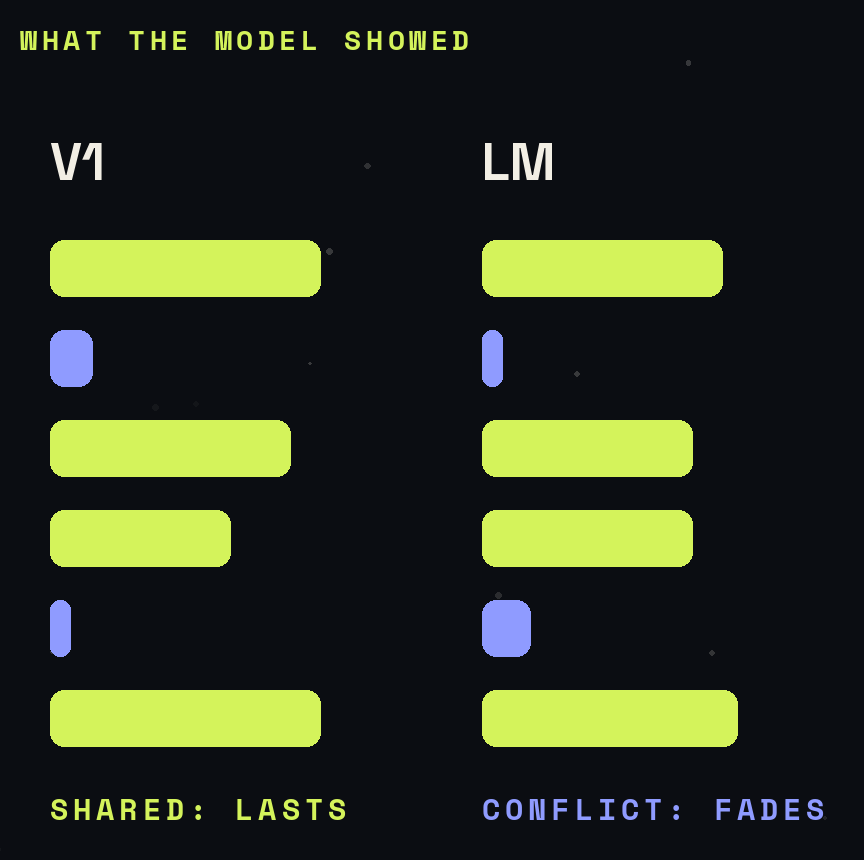 A schematic of the finding, not the paper’s data: shared activity lasts, conflicting activity fades.
How to picture it
Think of two witnesses comparing notes after seeing the same event. The details both remember (a red car, two people) stick. The details only one of them claims (it turned left; no, right) get dropped. Neither witness is in charge; agreement is what survives.
Why it matters
Different parts of the brain specialise in different aspects of what we sense, yet our experience of the world feels unified rather than a pile of separate signals. How those specialised areas coordinate is one of the big open questions in neuroscience, and consensus building offers a possible piece of the answer. It might also shed light on what happens when areas fail to agree. The researchers even suggest the idea could inform how AI systems handle conflicting streams of information.
The catch
This covers two visual areas, in mice, and much of the key result comes from a computer model fitted to their recordings rather than from direct measurement alone. Whether the same mechanism operates across the rest of the cortex, or in people, or when sight and sound disagree, is exactly what the team is now investigating.
Next time a shadow fools you for a moment, the argument may already be settling.
Sources
- Javadzadeh et al., Reciprocal connections dynamically build consensus between neocortical areas, Nature Neuroscience (2026)
- When what you see doesn't make sense, your brain does something remarkable, Cold Spring Harbor Laboratory via ScienceDaily (university news)
- Fig. 1a, Javadzadeh et al., Nature Neuroscience, CC BY 4.0 (cropped; thumbnail and Reel)