
Robotics
Drones that fly in a defibrillator
A computer simulation of the Paris region found that drones plus extra wall-mounted defibrillators could get one to more than 95% of cardiac arrests within five minutes, against 30–40% when someone fetches one by road.
When someone’s heart stops outside hospital, the shock from a defibrillator is one of the few things that can restart a normal rhythm, and each minute of delay lowers the odds of survival. Public defibrillators (AEDs) hang on walls in stations and shopping centres, but someone has to know where one is and run to get it. A team in Paris asked a simple question in a computer model: what if a drone flew one to the scene instead?
What they did
Emergency physician Hillary Minka of Lariboisière Hospital and colleagues used real records of out-of-hospital cardiac arrests from seven departments of the Île-de-France region around Paris, leaving out the city centre. They chopped the region into IRIS units, the smallest census areas used by France’s statistics office, and estimated how long an AED would take to reach the centre of each unit under three strategies: fetching an existing fixed AED by road, delivering one by drone, and a hybrid of drones plus more fixed AEDs. They also compared possible drone bases, including existing AED sites, mobile intensive-care units and fire stations.
The work was presented as an abstract at the European Emergency Medicine Congress on 26 September.
What they found
Access to fixed AEDs was patchy, especially in the countryside and on the outskirts of Paris. Covering those gaps with wall-mounted units alone would take 1,712 more on top of the 1,893 already there.
Drones changed the picture. In the hybrid set-up, the average time to get an AED fell by 3.76 minutes across all units, and in some places by more than ten. More than 95% of cardiac arrests could have an AED within five minutes, compared with 30–40% when the device was fetched by road. With 200 drone bases and 871 fixed AED sites, the model covered 99.4% of the 28,349 cases in the data.
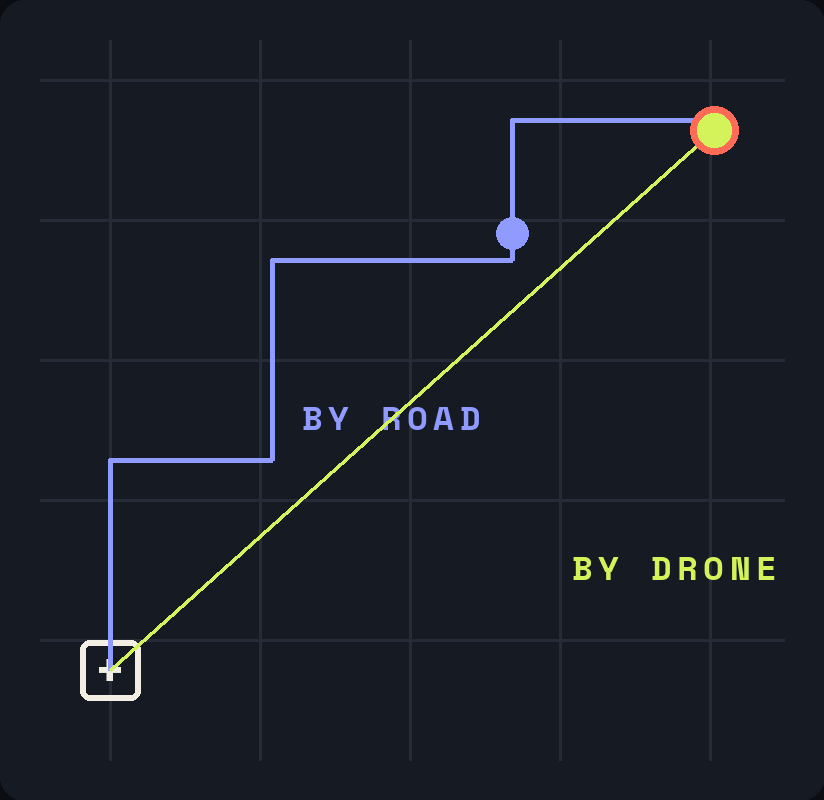 Roads twist and jam; a drone flies as the crow flies. That straight line is the whole advantage, and also the model’s biggest assumption.
How it works
The idea is the difference between a delivery van and a direct flight. In the model, a fixed AED serves a range of about 500 metres, while a drone base reaches about 3.9 kilometres. Fewer, well-placed bases could therefore cover a region that would otherwise need hundreds of extra wall units. When the drone lands, a bystander already at the scene would collect the AED and use it, with the emergency services talking them through it.
Why it matters
Where you have a cardiac arrest shouldn’t decide whether you survive it, but today it partly does. The study suggests that how defibrillators are spread out matters as much as how many there are, and that drones could fill the gaps in the suburbs and countryside where AEDs are scarce and traffic is slow. Minka stresses that drones would be an extra link in the chain, not a replacement for bystanders or ambulance crews.
The catch
No drones were flown. This is a simulation presented at a congress and not yet peer-reviewed, and it timed the drones along straight lines, without weather, air-traffic rules or other real-world hold-ups. It also assumes a bystander is there, willing and able to use the device, which is why an independent emergency physician on the congress committee stressed that CPR and AED training still come first. The authors say real-world trials are needed.
A drone can only bring the device; someone still has to open the box and follow the voice prompts.
Sources
- Drones could speed up delivery of automated external defibrillators to patients suffering cardiac arrest, European Society for Emergency Medicine via EurekAlert (press release on a congress abstract, not yet peer-reviewed)
- AED at Agualva-Cacém station, DiogoBaptista, Wikimedia Commons (CC0; cropped, used in the Reel)

Second Look promised We'll give this a Second Look when drones are tested in real emergencies, or the study is peer-reviewed.