
Biology
The fire amoeba sets a heat record
A single-celled amoeba from a California hot spring grows and divides at 63°C, the highest temperature known for any plant, animal, fungus or other complex cell.
Every plant, animal and fungus we know of dies somewhere below 60°C. A newly described amoeba from a volcanic hot spring in California doesn’t: it keeps growing and splitting into daughter cells at 63°C (145°F), researchers report in Cell. That’s a new heat record for the eukaryotes, the branch of life whose cells keep their DNA in a nucleus, which includes us.
What they did
Between 2023 and 2025, microbiologist Beryl Rappaport and colleagues in Angela Oliverio’s lab at Syracuse University collected water from geothermal springs in Lassen Volcanic National Park and tried to grow whatever amoebas were in it. Their hottest dish started at 57°C, because that was the highest temperature any amoeba had been recorded growing at, Science News reports.
One amoeba growing there didn’t look like the previous record holder, Echinamoeba thermarum. So the team turned the heat up. It kept dividing at 63°C, above the 60°C managed by some algae and fungi, which had been the ceiling for complex cells. Pushed further, it doesn’t grow but can go dormant and survive up to 70°C. They named it Incendiamoeba cascadensis, “fire amoeba from the Cascades”, after the volcanic range where Lassen sits.
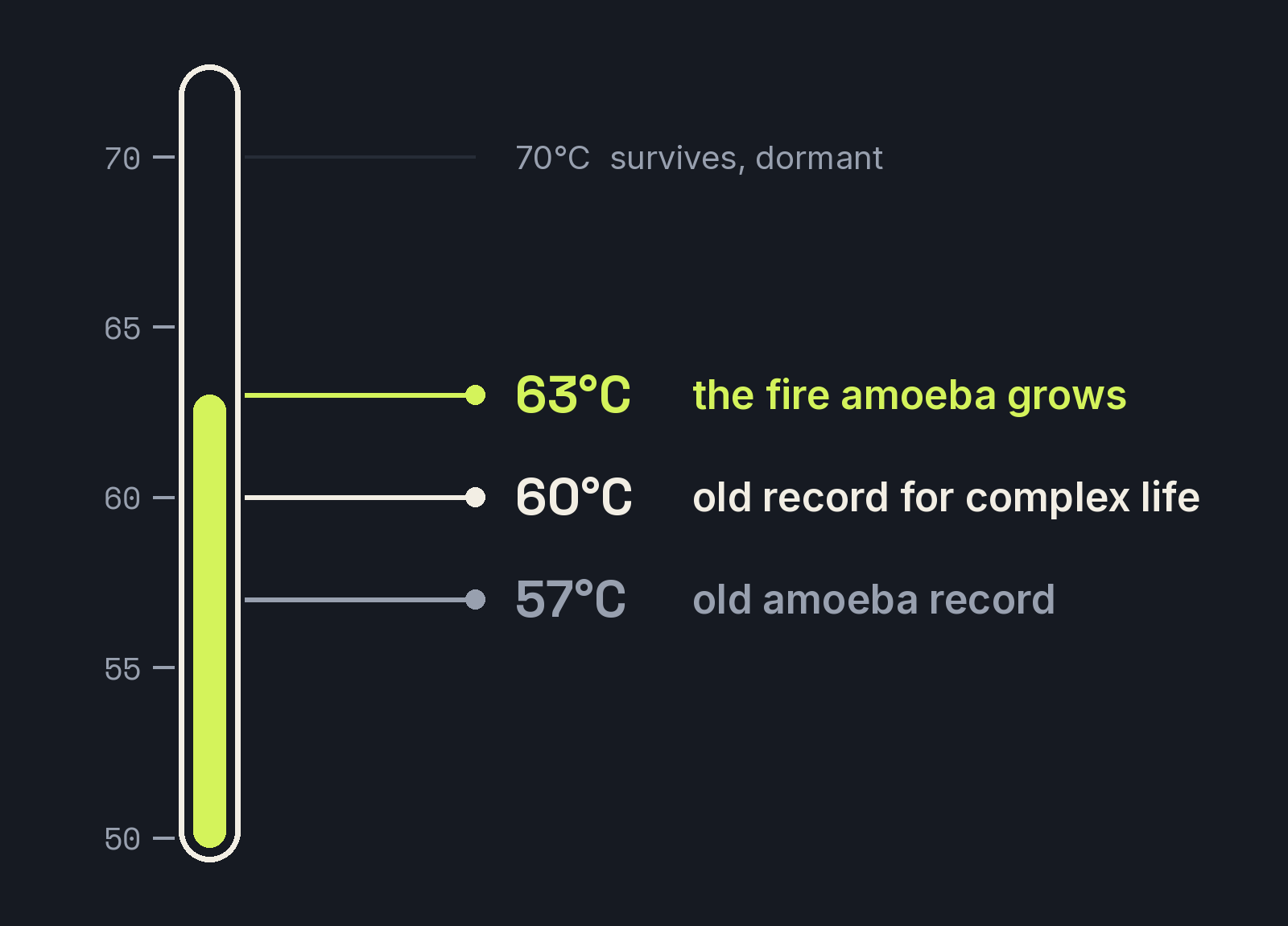 Three degrees doesn’t sound like much, but it moves a limit that had held for every known complex cell.
How it copes
Heat is hard on cells mostly because it makes proteins lose their shape and stick to each other, like egg white turning solid in a pan. The fire amoeba seems to borrow a defence used by heat-loving bacteria and archaea: chemical features on the outside of its proteins that discourage that clumping.
It also has two body forms and can switch between them. Rappaport describes one as slow and suited to feeding and the other as fast, perhaps for moving away when the water gets too hot. In a spring whose temperature swings, being able to change gear may matter as much as raw heat tolerance.
Why it matters
The heat ceiling for complex cells marks where life with a nucleus can and can’t survive. Raising it widens the set of hot environments, on Earth and potentially elsewhere, where scientists should look for more than just bacteria and archaea. It also points to how cells can be built to cope with heat: the fire amoeba’s genes are now a guide to which changes make that possible.
For scale, simpler life still wins by a long way: the archaeon Methanopyrus kandleri holds the record for any organism, growing at 122°C.
The catch
This is a single newly described species from one national park, grown in lab cultures, so we don’t yet know how common heat-tolerant amoebas are or how the fire amoeba behaves in the wild day to day. The researchers themselves say they don’t know where the real upper limit sits and see no reason 63°C should be it, so this record may not last.
Somewhere in a hotter spring, the next record holder may already be waiting to be cultured.
Sources
- Meet the 'fire amoeba,' a record-breaking survivor of extreme heat, Science News
- Rappaport et al., A geothermal amoeba sets a new upper temperature limit for eukaryotes, Cell (2026)
- Aquamarine water pool at Bumpass Hell, Frank Schulenburg, Wikimedia Commons (CC BY-SA 4.0; thumbnail and post cover)
- Inside Bumpass Hell, Bryan Bulmer, Wikimedia Commons (public domain)

