
Physics
Did gravity's strength ever change?
Using the 2017 collision of two neutron stars, physicists found that G, the number that sets gravity's strength, hasn't drifted by more than a few billionths per year.
About 130 million years ago, two neutron stars, the collapsed cores of dead stars, spiralled into each other in the galaxy NGC 4993. On 17 August 2017, the gravitational waves from that collision reached Earth and were caught by the LIGO and Virgo detectors. A new study in Communications Physics uses that event to ask a deceptively simple question: was gravity as strong back then as it is today?
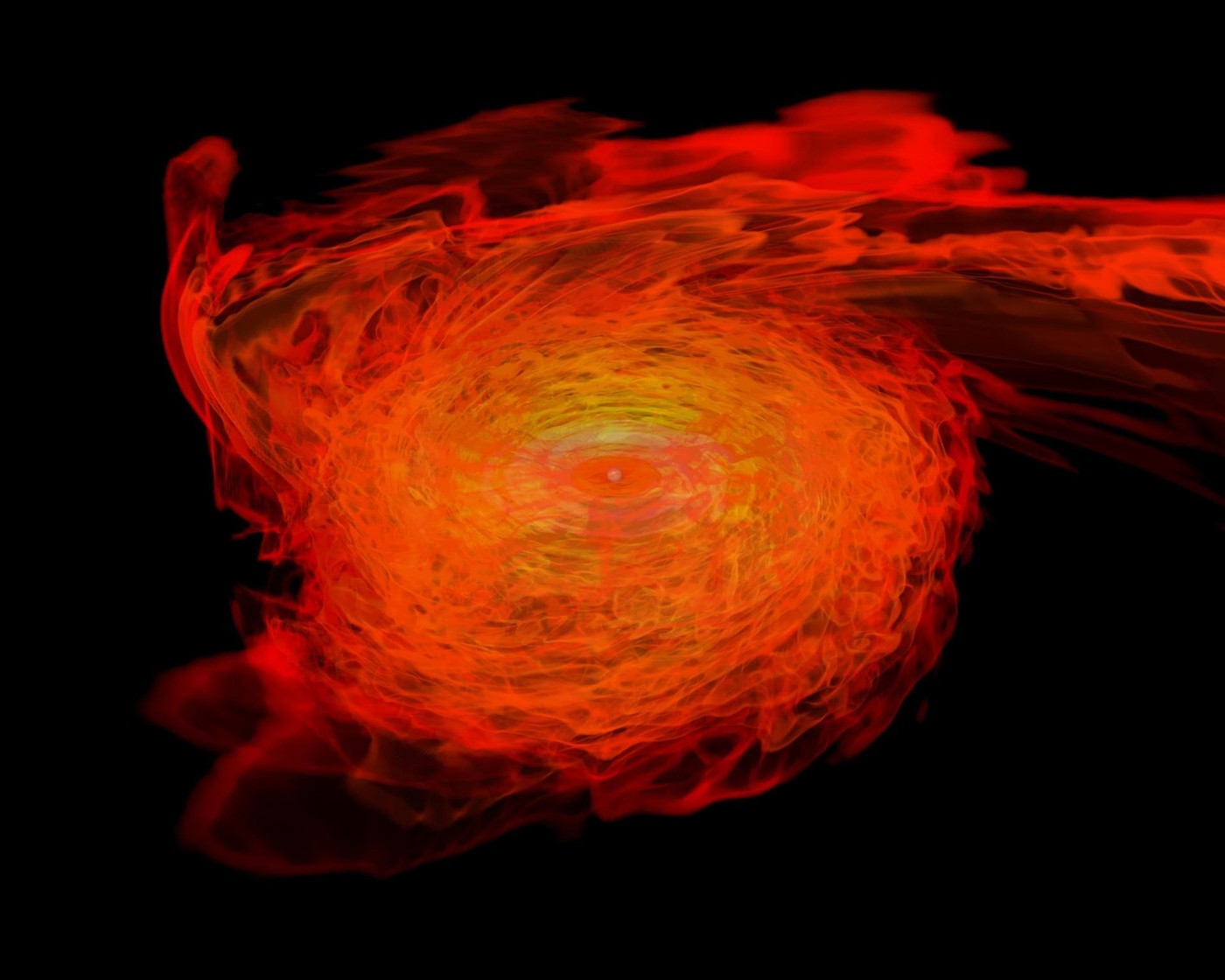 A simulation of two neutron stars merging. NASA/GSFC, public domain.
Why a constant should stay constant
Gravity’s strength is set by one number, Newton’s constant G. In Einstein’s general relativity, G can’t change. It’s a direct consequence of the strong equivalence principle, which says the results of any local experiment, gravitational ones included, don’t depend on where or when you do them. If G drifted over time, that principle would break, and so would a pillar of Einstein’s theory. Testing whether G changes is therefore a test of Einstein himself.
One ripple, three unknowns
Gravitational waves carry the answer, but it’s tangled up with other things. A change in G between the source and us would alter the strength of the arriving wave. So does the distance to the source, and so does how the binary’s orbit was tilted relative to us. From the ripples alone, the authors note, a varying G is strongly degenerate with distance and tilt: turn one knob and another can compensate, leaving the same signal.
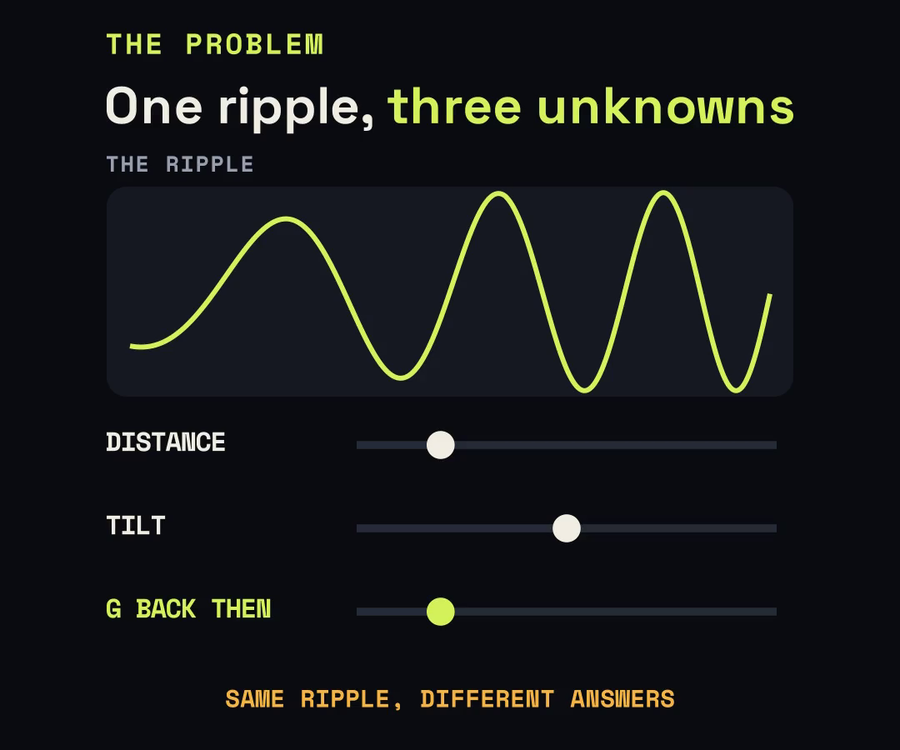 From the ripple alone, different combinations of distance, tilt and G look the same.
The flash that untangled it
This collision was special because it also produced light. A gamma-ray burst arrived 1.7 seconds after the gravitational waves. Telescopes followed up: the Hubble Space Telescope fixed the distance at about 40.7 megaparsecs, and radio observations of the burst’s afterglow pinned down the tilt of the orbit. With distance and tilt fixed by light, whatever remained in the gravitational-wave signal could be read as a measurement of G itself.
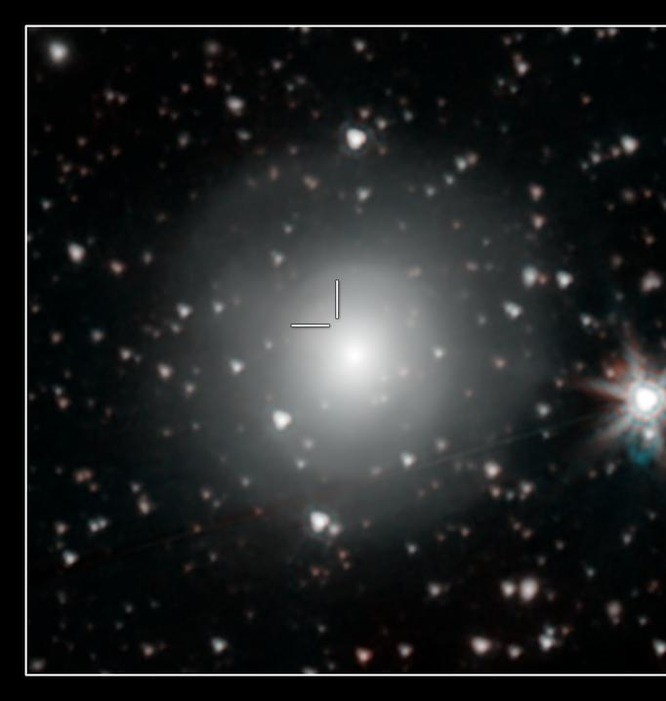 NGC 4993, the galaxy that hosted the collision, seen by Spitzer. NASA/JPL-Caltech, public domain.
The answer: no change
The team’s joint analysis of the gravitational-wave data and the light found no sign of a varying G. They constrain how fast G could be changing to between about −3.4 and +0.5 billionths per year, which they describe as “the most stringent bounds obtained to date from real GW observations.” An earlier bound from a different gravitational-wave event was looser by roughly thirteen powers of ten.
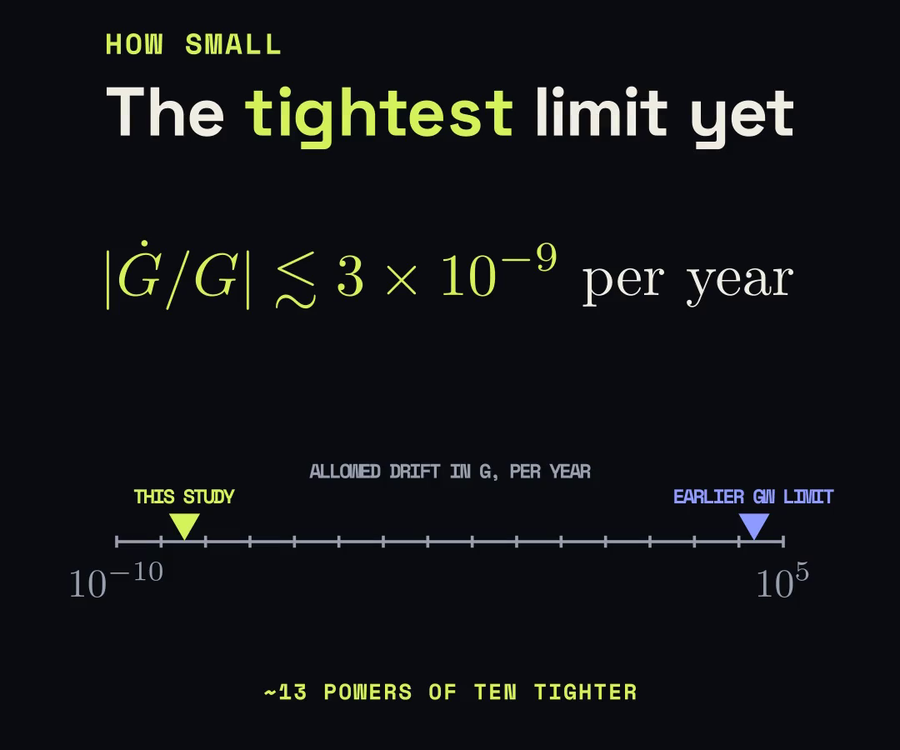 The new limit sits about thirteen powers of ten below the earlier gravitational-wave bound.
The catch: the result rests on a single collision, and on the telescopes’ measurements of its distance and tilt. It’s the tightest test of its kind from gravitational waves, not from every method; other techniques, such as lunar laser ranging and pulsar timing, also constrain G.
Still, it’s a striking thing: a signal that travelled for 130 million years, checked against a flash of light that came along with it, says gravity then was gravity now.
Sources
- Testing the strong equivalence principle with multimessenger binary neutron star mergers, Zhu et al., Communications Physics (2026)
- The same paper on arXiv (2603.25413), CC BY 4.0
- Spitzer observes neutron star collision, NASA/JPL-Caltech (image)
- Neutron stars rip each other apart to form black hole, NASA/GSFC (image)