
AI
An AI that doesn't write
Jev, a new model from TypeSafe AI, answers by scoring a fixed set of possible answers instead of generating text. Here's the idea, and what we don't know yet.
Most AI models answer you by writing: a chatbot produces its reply a piece at a time, each new piece conditioned on everything it has written so far. Jev, released in limited early access by San Francisco startup TypeSafe AI on 15 September, doesn’t write at all.
Scoring answers instead of writing them
With Jev, you supply the question and the possible answers. It returns a typed result: the option it picks, a probability for every option, and a confidence score. TypeSafe offers three kinds of question: pick one option from a list (“choice”), rate something against ordered levels (“score”), and judge whether a statement is true (a yes/no probability). Several questions can go in one request, and the documentation says they are “evaluated in parallel and in isolation.”
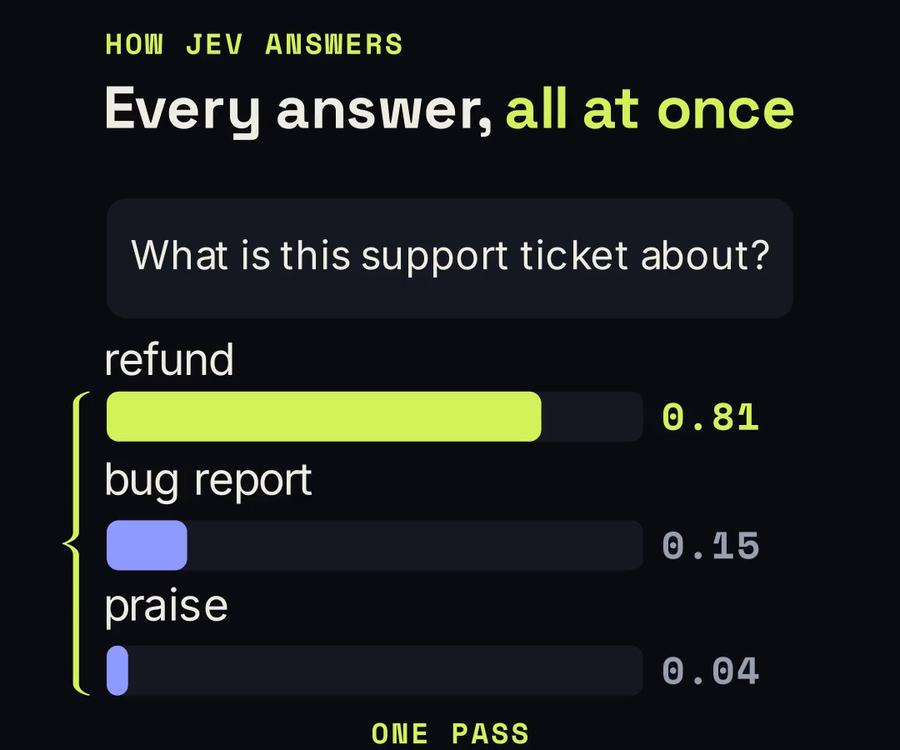 Jev scores every answer you give it at once, rather than writing a reply.
Because the answer is always one of the options you provided, the output can’t wander into something made up. That’s why developers quoted by TechCrunch describe it as unable to hallucinate. The company calls Jev the first “System One” model, after the fast, intuitive thinking Daniel Kahneman described, as opposed to slow, deliberate reasoning.
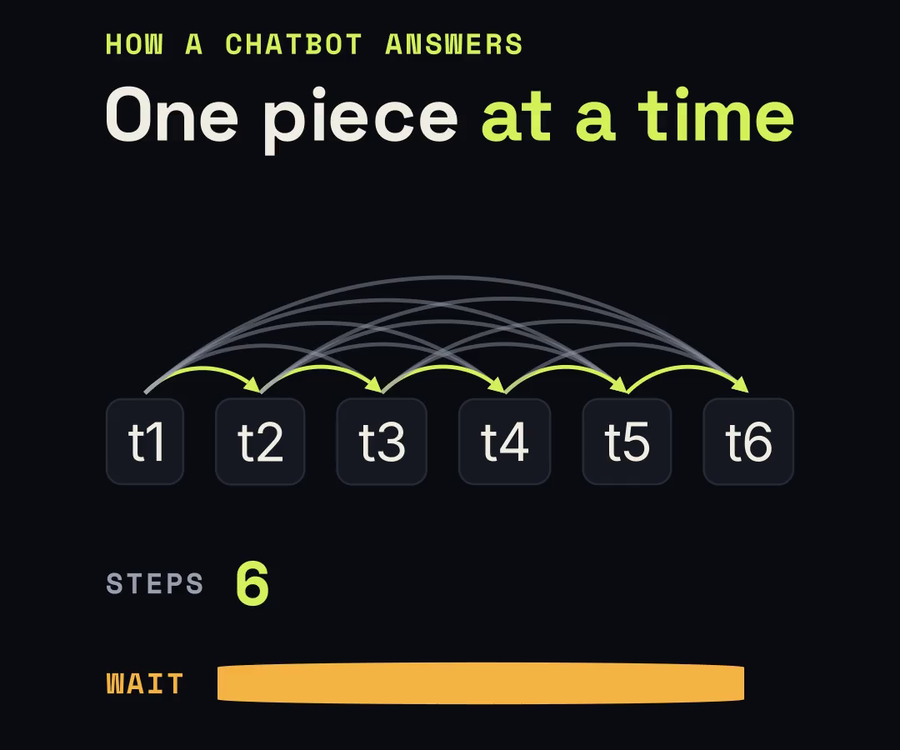 A chatbot’s reply grows one piece at a time, each depending on all the pieces before it.
The real goal: calibration
A probability is only useful if it means what it says. A forecaster is calibrated when, in Philip Dawid’s phrasing, of all the events it gives a 30% chance, about 30% actually happen. For Jev, that would mean: when it says 70%, it’s right about seven times in ten. TypeSafe trains the model for this with a method it calls reinforcement learning for calibrated decisions, and says it was trained on synthetic data.
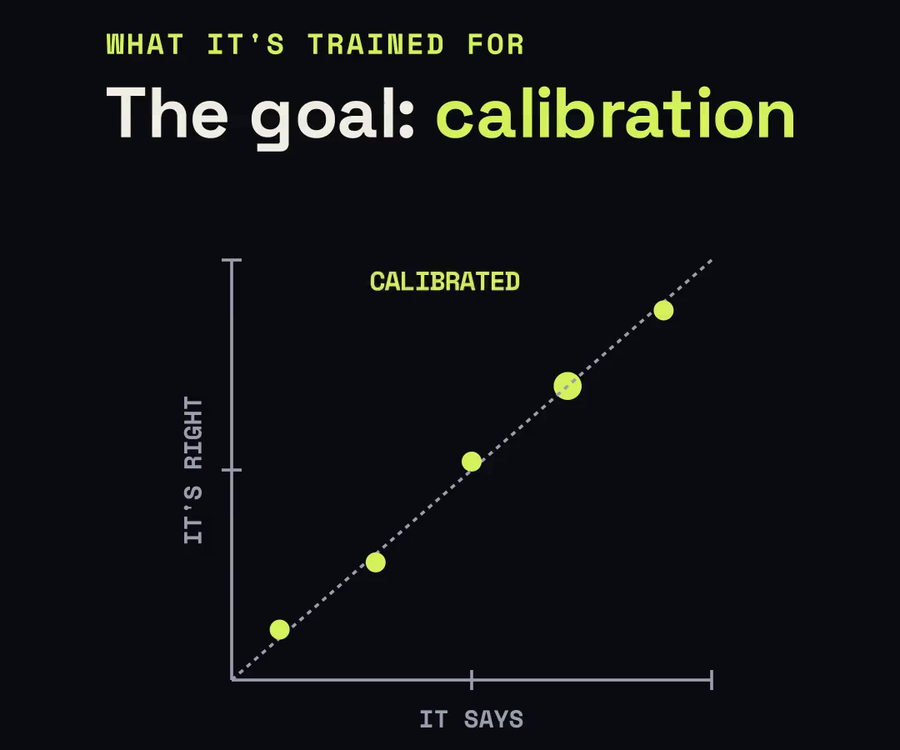 Calibrated means the stated probability matches how often the answer turns out right.
Fast and cheap, by the company’s own tests
With no text to generate, Jev is quick: TypeSafe reports response times of 70 to 500 milliseconds and claims it is 40 to 200 times faster, and 40 to 400 times cheaper, than frontier LLMs. The company itself says these figures come from internal workflows and are likely to sit at the high end of real-world results. Early users quoted by TechCrunch reported large speed-ups too, though one noted it cost more than some alternatives while giving “real probability scores.”
The catch, and it’s a real one, is that it can’t chat; it only picks among answers you supply; and TypeSafe has not published how the model is built.
What we don’t know yet
Founder Diogo Almeida, a former OpenAI researcher, has been “tight-lipped about the model’s architecture,” TechCrunch reports, and some outside observers suspect it sits on top of an open-weight LLM. There is no paper or technical report to check. Until there is, Jev is best understood as a new interface to AI, one that asks for calibrated probabilities over fixed choices, rather than a proven new architecture. The idea is worth watching either way: many decisions software makes every day are exactly this shape, and a number you can trust is more useful than a paragraph you have to parse.