
Consumer tech
A contact lens that reads stress in tears
A soft contact lens with printed graphene electrodes detected serotonin in lab tests at levels far below those normally in tears, a first step toward a wearable, objective stress gauge; no person has worn it yet.
Stress is usually measured by asking people how they feel, on questionnaires or in diaries. Researchers at the Terasaki Institute for Biomedical Innovation in Los Angeles want a chemical reading instead, and they’re looking for it in tears. Their soft contact lens can detect serotonin, a chemical messenger tied to mood, at concentrations far below what tears normally contain, IEEE Spectrum reports on the study in Science Translational Medicine.
What they built
The lens is made of hydrogel, the soft, water-rich material of ordinary soft lenses. Inside it, the team led by Yangzhi Zhu printed electrodes of graphene and silver in winding, serpentine lines, a shape that can bend and stretch without breaking. The graphene is coated with ferrocene, a compound that helps the sensor pick up serotonin reliably.
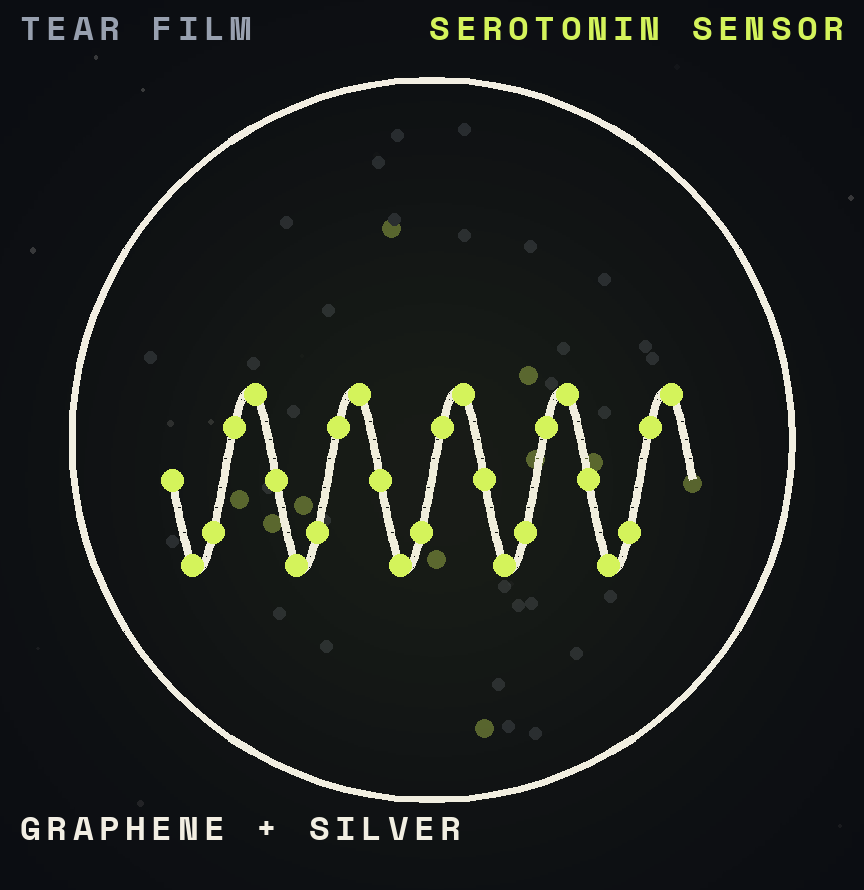 The winding trace flexes with the lens; the coating along it responds to serotonin, not to everything else in tears.
One way to picture it: a net woven into the lens. The winding threads give without snapping, and the coating acts as bait for one particular kind of molecule in a crowded fluid. The hard part, Zhu says, is being sensitive enough to catch serotonin’s tiny amounts while ignoring everything else in tears.
What they tested
In lab dishes of artificial tears spiked with serotonin, the lens detected as little as 72 trillionths of a mole per litre, while tears contain around 15 billionths on average, so it can register roughly 200 times less than the usual level. It kept working after more than 28 days of repeated flipping, folding, stretching and twisting.
Tears from 10 volunteers, collected before and after a round of public speaking and maths challenges, were then tested in the dish, and serotonin fell with stress, as expected. In mice kept stressed by limiting their movement for a few hours a day, serotonin dropped by a similar amount in blood and in tears, a hint that tears could mirror what’s in the blood. Finally, a lens sat on the eye of an anaesthetised pig for about five minutes, detected serotonin added in artificial tears, and caused no sign of irritation or infection.
Why it matters
Serotonin changes more slowly than cortisol, the usual stress hormone, so Zhu sees the two as complementary: cortisol for the immediate response, serotonin for longer-term load. A lens that tracks body chemistry continuously could make stress measurable in a way questionnaires can’t. Caltech’s Wei Gao, who wasn’t involved, describes it as part of a move in wearables from physical signals like heart rate toward molecules.
The catch
No one has worn this lens yet. The human tears were tested in a dish, the pig test lasted five minutes, and the readings in both relied on thin wires to external equipment. A wireless version with a tiny NFC chip exists only as a proof of concept, and the team says it still needs optimisation, safety testing and validation. They also don’t yet know how tear serotonin varies between people, over the day, or with eye conditions and disease.
The team’s next goal is a lens that reads several molecules at once.
