
Health
Bach and a VR forest lower blood pressure
In a trial of 130 emergency patients with very high blood pressure, adding a VR nature scene and classical music to usual medication brought pressure down a little faster in the first 15 minutes, and eased anxiety.
People who turn up in an emergency department with dangerously high blood pressure are often frightened, and fear itself can push pressure higher. A team in Ankara, Turkey, tried giving some of them a VR headset showing a quiet forest river, plus a playlist of Bach, Mozart and Debussy, alongside their usual medication. In a trial of 130 patients, presented at the European Emergency Medicine Congress on 26 September, their blood pressure fell a little faster in the first 15 minutes.
What they did
The patients had what doctors call hypertensive urgency: a top reading of 180 mmHg or more, or a bottom reading of 110 or more, but no signs of damage to organs such as the heart, brain or kidneys. The researchers, led by emergency physician Safa Dönmez, randomly split them into two groups of 65. Everyone received the standard blood-pressure medication.
One group got nothing else. The other also wore a VR headset showing a river running through a forest, with tall trees and a wooden suspension bridge, while calm classical music played from a phone. The team measured blood pressure at 15, 30, 60, 90 and 120 minutes, using mean arterial pressure, a single number that blends the top and bottom readings. Patients came in at around 130 to 138 on that scale; a normal value is roughly 70 to 100.
What they found
After 15 minutes, the usual-care group’s mean pressure had dropped by 8% and the VR group’s by 12%. At 30 minutes the gap had nearly closed, 14% against 15%, and from 60 minutes on the two groups were essentially the same. In absolute terms, the researchers say the VR group dropped roughly 4 to 5 mmHg more at the 15-minute mark, a difference unlikely to be due to chance.
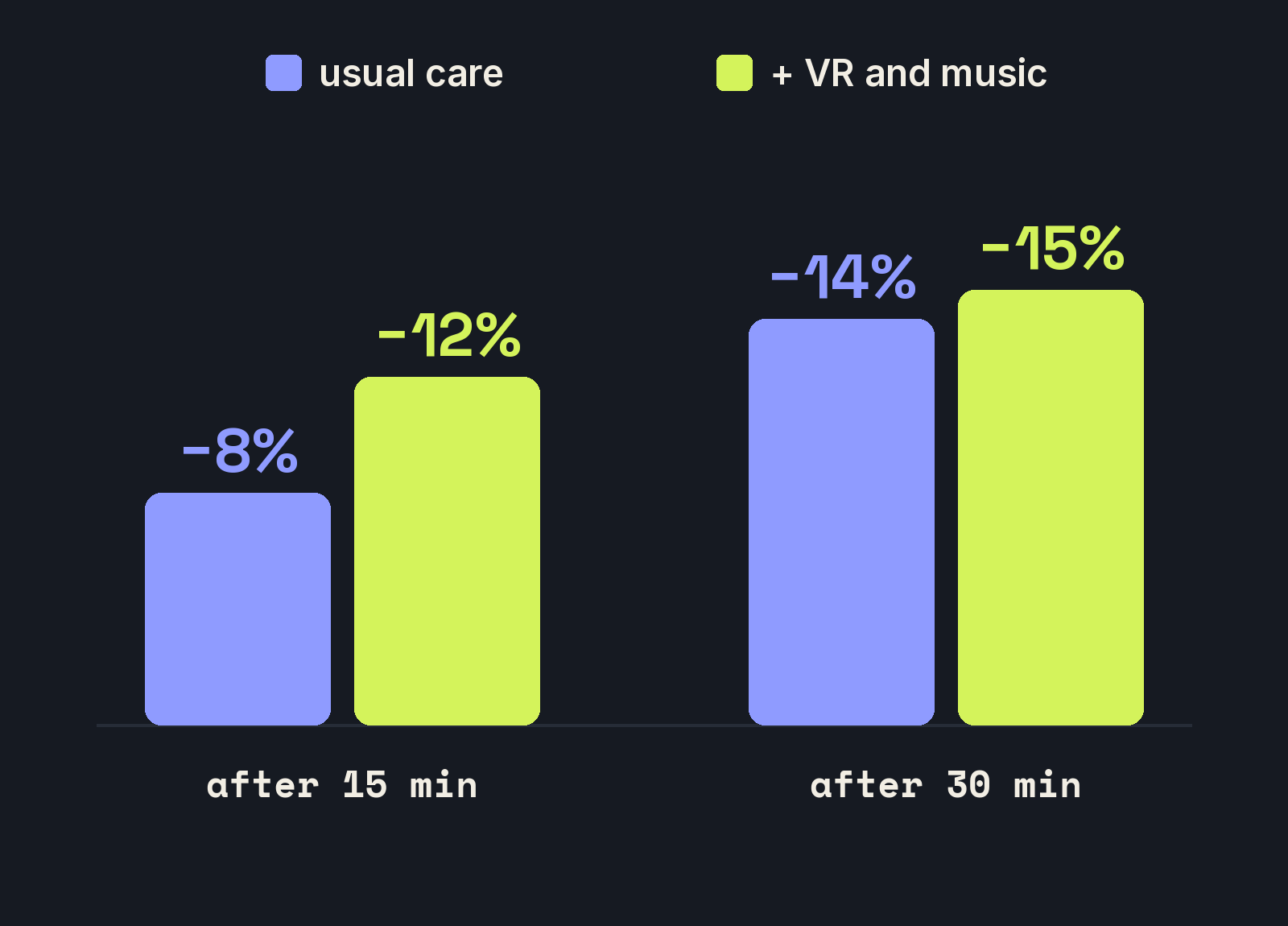 Percentage fall in mean arterial pressure. The head start is early and short-lived.
Anxiety scores moved too. The VR group started out more anxious on a standard questionnaire, and its scores fell by about eight points on average, compared with about four in the usual-care group. By the end of two hours, both groups had ended up at similar levels.
Why calm might matter
The idea is straightforward. Anxiety triggers stress hormones, which narrow blood vessels, which raises pressure. A busy emergency department, with its noise, lights and uncertainty, doesn’t help. If something cheap and harmless can break that loop for a few minutes, it could help doctors get pressure under control sooner. The researchers see it as a support for early treatment, not a way to control blood pressure over the long term, and an independent emergency physician on the congress committee stressed that it was used alongside medication, not instead of it.
The catch
This is a congress abstract, not a peer-reviewed paper. It comes from a single hospital with just two hours of follow-up, and despite randomisation the VR group started with slightly lower blood pressure, which the team tried to adjust for by comparing percentage drops. Headset and music were always given together, so there’s no telling which one did the work. And patients and staff could see who was wearing a headset, so a placebo effect can’t be ruled out.
The team’s next step is a larger, multi-hospital study that tests the visuals and the music separately, and lets patients choose their own playlist.
Sources
- Virtual reality and classical music help to reduce blood pressure in patients in an emergency department, European Society for Emergency Medicine via EurekAlert (press release on a congress abstract, not yet peer-reviewed)
- Manistee River Trail bridge, US Forest Service, Wikimedia Commons (public domain; thumbnail and post cover)
- Manistee River Trail, USFS Eastern Region, Wikimedia Commons (public domain)


Second Look promised We'll give this a Second Look when a larger, peer-reviewed trial is published.