
Earth science
Earth's core is stretching your day
A new Nature study finds that gravity pulling between Earth's lopsided inner core and dense rock in the mantle drives the few-millisecond swings in the length of a day over decades.
A day on Earth isn’t exactly 24 hours. Measured precisely, it drifts: a few thousandths of a second longer for some years, a few thousandths shorter for others, in slow swings that take decades. A new study in Nature says a big part of the reason sits more than 5,000 kilometres below your feet, in a tug of war between the inner core and the rock above it.
What they found
Huifeng Zhang, a PhD student, and Mathieu Dumberry, a physics professor, both at the University of Alberta, looked at why the length of a day changes on timescales of decades. Their answer, as the university describes it, is a balance of two twisting forces, or torques, acting on the mantle, the thick layer of rock between the core and the crust.
The first is gravity. Earth’s inner core is a solid ball of iron, and it isn’t perfectly round. The mantle isn’t uniform either: it has patches of denser rock. Gravity pulls the core’s bulges and those dense patches toward each other. When the inner core’s spin speeds up or slows down a little, as it does over a few decades, that pull twists the mantle along with it. The study’s title says it plainly: this gravitational torque is what drives the multidecadal changes.
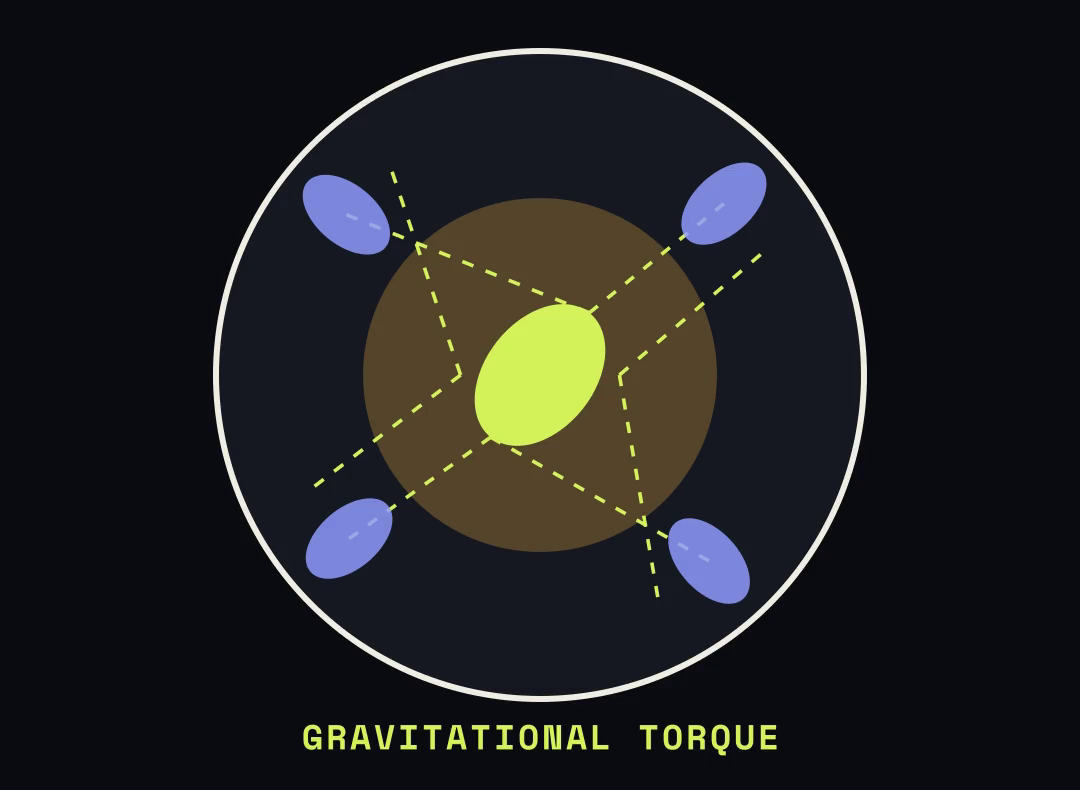 Schematic. The layers are to scale; the core’s lopsidedness and the dense patches are exaggerated so you can see them.
The second force pushes back. Where the molten outer core meets the mantle, there is friction and electromagnetic drag, because the liquid iron carries electric currents that interact with the magnetic field. Small shifts in the balance between the gravitational pull and this drag, the researchers conclude, are what make the day a little longer or shorter.
How a twist changes the day
The physics behind it is one of the oldest rules of rotation: a torque changes how fast something spins.
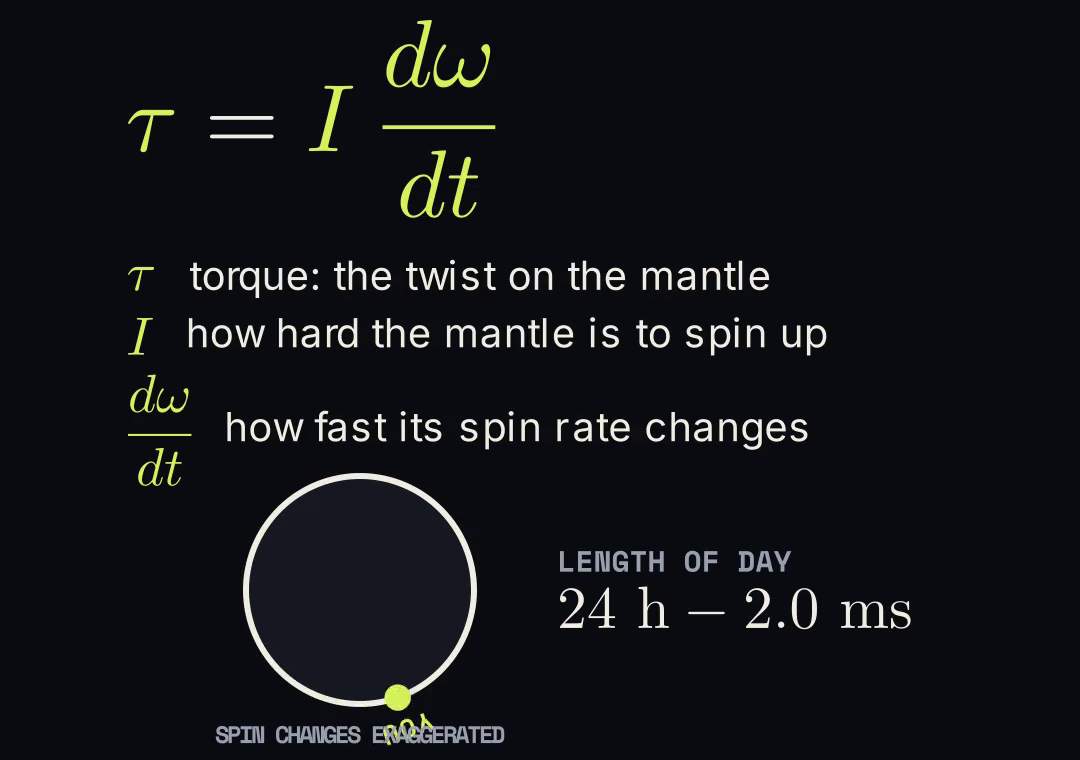 τ = I dω/dt: the twist on the mantle, how hard it is to spin up, and how fast its spin changes. The spin change in the animation is exaggerated.
Here τ is the torque on the mantle, I is its moment of inertia (how hard it is to spin up or slow down), and dω/dt is how quickly its spin rate changes. The mantle carries the crust, the oceans and you. So when the net twist on it changes, the whole surface turns a touch faster or slower, and the length of the day changes with it.
How small is small
The swings are a few milliseconds over a few decades. A day lasts 86,400,000 milliseconds, so a change of 3 milliseconds is about 3.5 parts in a hundred million. You would never notice it, but precise clocks and satellites do: timekeepers track these changes to keep our clocks lined up with the Earth’s actual spin.
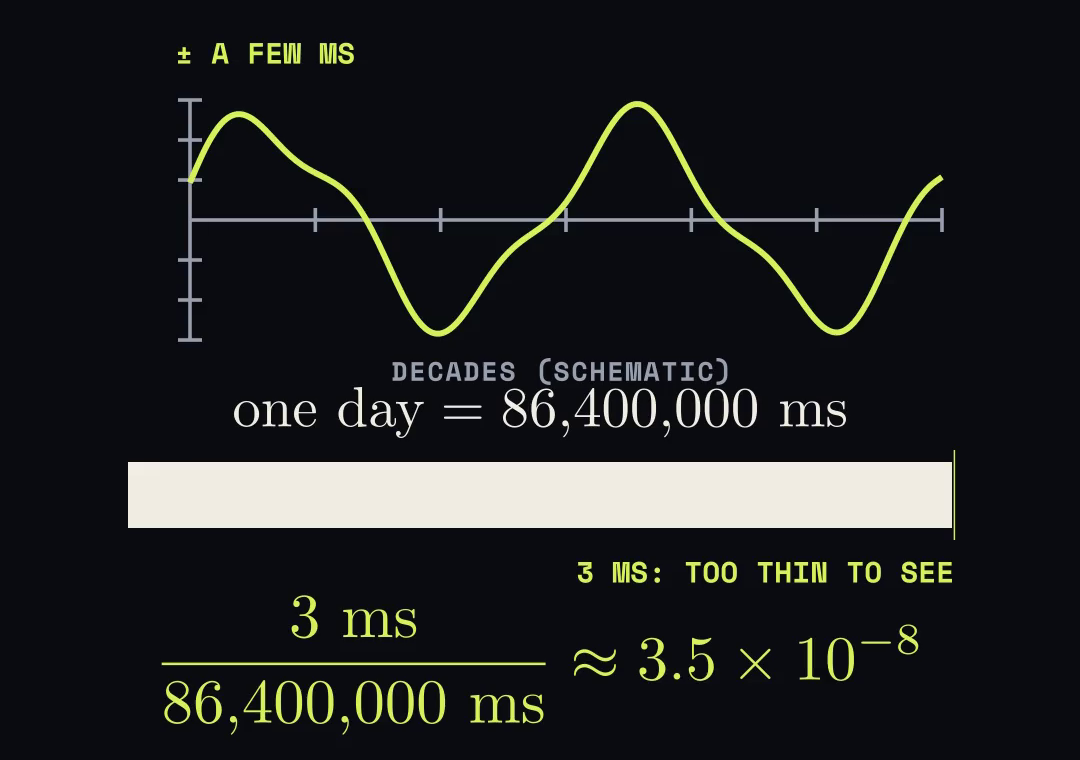 The decade wave is schematic; the ratio is real arithmetic.
Why it matters
Pinning the decade-long swings on a specific mechanism, gravity between the inner core and the mantle, gives a way to read the length of the day as a signal from deep inside the planet. Tiny changes measured at the surface become a window onto how the inner core moves and how the mantle’s rock is arranged.
The coverage we could read describes the mechanism but not the size of each torque or how well the model matches every past swing, and we could not open the paper itself. This study is about the slow, decades-long part of the changes, not every millisecond of them.
Your day is a few milliseconds long or short partly because of a slow tug of war 5,000 kilometres down.
Sources
- Gravitational torque drives multidecadal variations in length of day, Zhang & Dumberry, Nature (2026) (paper; details checked via Crossref, the Nature page itself was not reachable from our tools)
- Earth's deep secret, why a day isn't always the same length, Phys.org (University of Alberta news, via Phys.org)