
Physics
Hydrogen's faint glow maps dark energy
The CHIME radio telescope detected the 21-centimetre glow of hydrogen from when the universe was about 5 billion years old using its own data alone, a first that opens a cheaper way to study dark energy.
A telescope with no moving parts has picked up one of the faintest signals in astronomy: the radio glow of hydrogen gas from when the universe was about 5 billion years old. For the first time, the Canadian Hydrogen Intensity Mapping Experiment, or CHIME, detected it using only its own data, the team reports in two papers in The Astrophysical Journal.
A telescope that never moves
CHIME sits near Penticton in British Columbia and is hosted by the National Research Council of Canada. Instead of a steerable dish, it uses fixed reflectors and lets the Earth’s rotation sweep the sky past them, mapping the entire northern sky every day. It was built by the University of British Columbia, McGill University, the University of Toronto, the NRC’s Dominion Radio Astrophysical Observatory and Arizona State University.
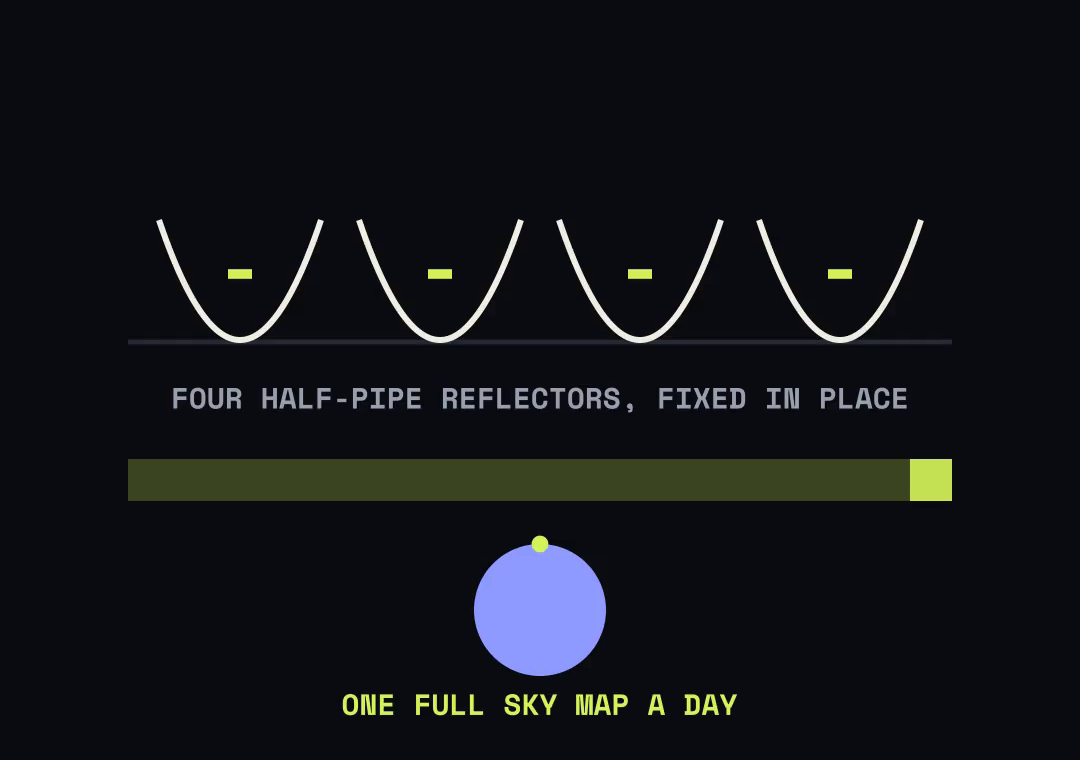 Schematic: the reflectors stay still; the Earth does the scanning.
Why hydrogen’s glow is a ruler
Neutral hydrogen atoms give off radio waves with a wavelength of 21 centimetres. As the universe expands, that light is stretched on its way to us, by a factor of (1 + z), where z is the redshift. So the wavelength we receive tells us how far the light has travelled, and each radio frequency CHIME listens to corresponds to a slice of the universe at a particular distance.
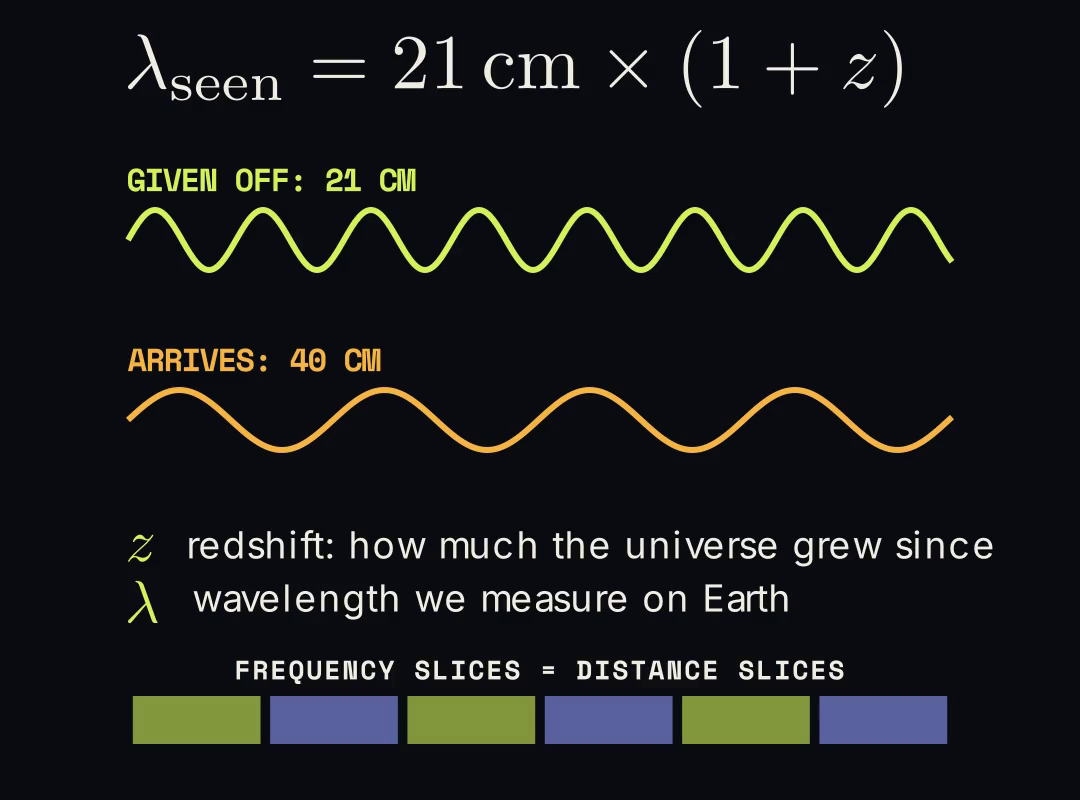 λ_seen = 21 cm × (1 + z). At the redshifts in this study, z ≈ 1, a 21-cm wave arrives roughly twice as long.
The signal is extremely weak. By this point in cosmic history only about 2% of the universe’s hydrogen was still in neutral atomic form, and it is buried under radio noise from our own galaxy. Until now, this glow had only been detected by cross-correlating radio maps with galaxy surveys from other telescopes. Using 94 nights of CHIME data from 2019, the team found it in CHIME’s data alone.
Why it matters for dark energy
Mapping where the hydrogen is reveals how matter was spread out at different times, and that pattern tracks how fast the universe was expanding. That makes it a tool for studying dark energy, the unknown effect speeding up the expansion. Doing it with one telescope costs a fraction of a large galaxy survey, and CHIME has nearly seven years of observations still to analyse, with plans to reach back to when the universe was about 3 billion years old.
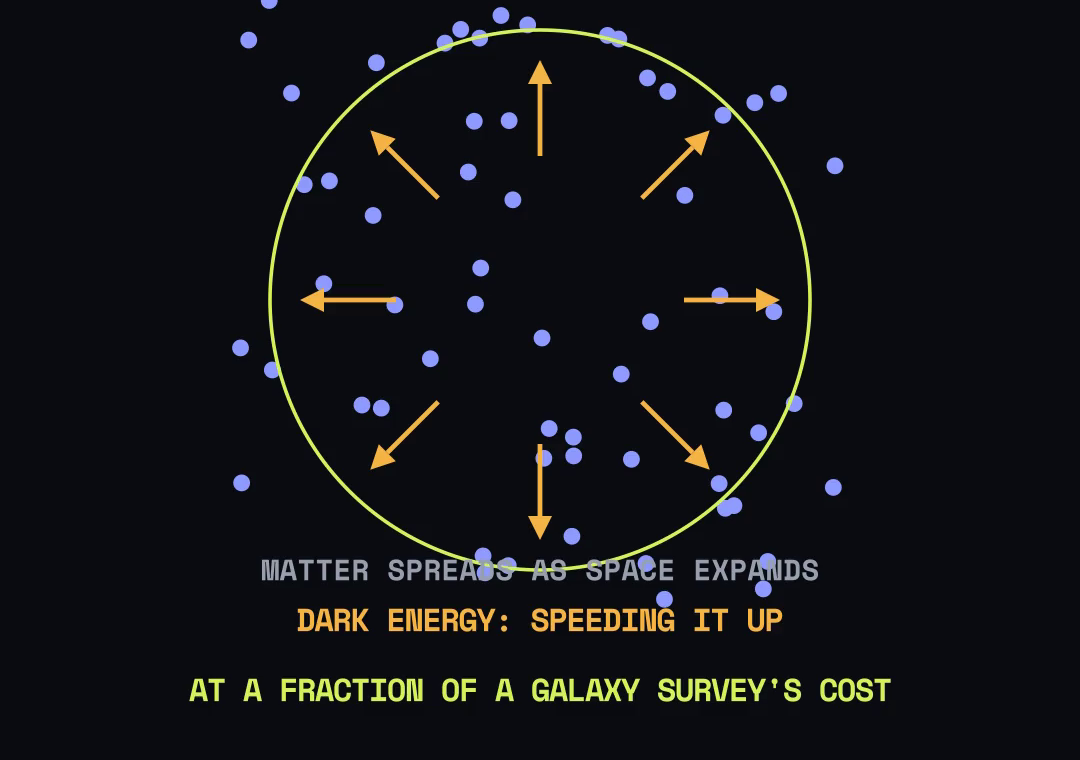 Schematic: the hydrogen map traces how matter spread as the universe expanded.
This first detection uses a small fraction of CHIME’s data, and on its own it doesn’t yet measure dark energy; it shows the signal can be found and measured without help from galaxy surveys. The bigger payoff depends on the rest of the data and on keeping the much brighter foreground radio noise under control.
One fixed telescope can now map the universe’s hydrogen by itself, a cheaper route to one of physics’ biggest questions.
Sources
- Faint radio glow of distant hydrogen detected, opening a new way to study dark energy, Phys.org
- Detection of the Cosmological 21 cm Signal in Autocorrelation at z ∼ 1 with the Canadian Hydrogen Intensity Mapping Experiment, The Astrophysical Journal (2026) (CHIME collaboration; details checked via Crossref)
- Interpretation of 21 cm Autopower Spectrum Measurement at z ∼ 1 by the Canadian Hydrogen Intensity Mapping Experiment, The Astrophysical Journal (2026) (companion paper)