
Physics
Scientists trapped a ray of light
A headline keeps claiming scientists froze light and turned it solid. Light has never turned solid, but it has been slowed to 17 metres a second, stopped inside a cloud of atoms, and released again on command.
Every so often a headline announces that scientists have frozen light and turned it solid. The most recent wave came with an Italian study in 2025, which actually made light behave as a supersolid, a strange state that is ordered like a crystal yet flows without friction. Nothing in it was stopped or stored. But light really has been brought to a standstill, and the way it was done is worth knowing, because light never became solid: it was held.
Not matter, but energy and information
When people say light was “frozen”, it didn’t turn into matter. No electrons or protons appeared. What can be trapped is light’s energy and the information it carries: the shape and timing of a pulse. Where that information goes, and how it comes back, is the whole trick.
A cloud made see-through
At Harvard, Lene Hau’s team cooled a cloud of sodium atoms to about a billionth of a degree above absolute zero. On its own, a cloud like that absorbs the light that the experiment sends in. A second beam, the control (or coupling) laser, changes that: while it shines, the cloud becomes transparent to the probe light, an effect called electromagnetically induced transparency.
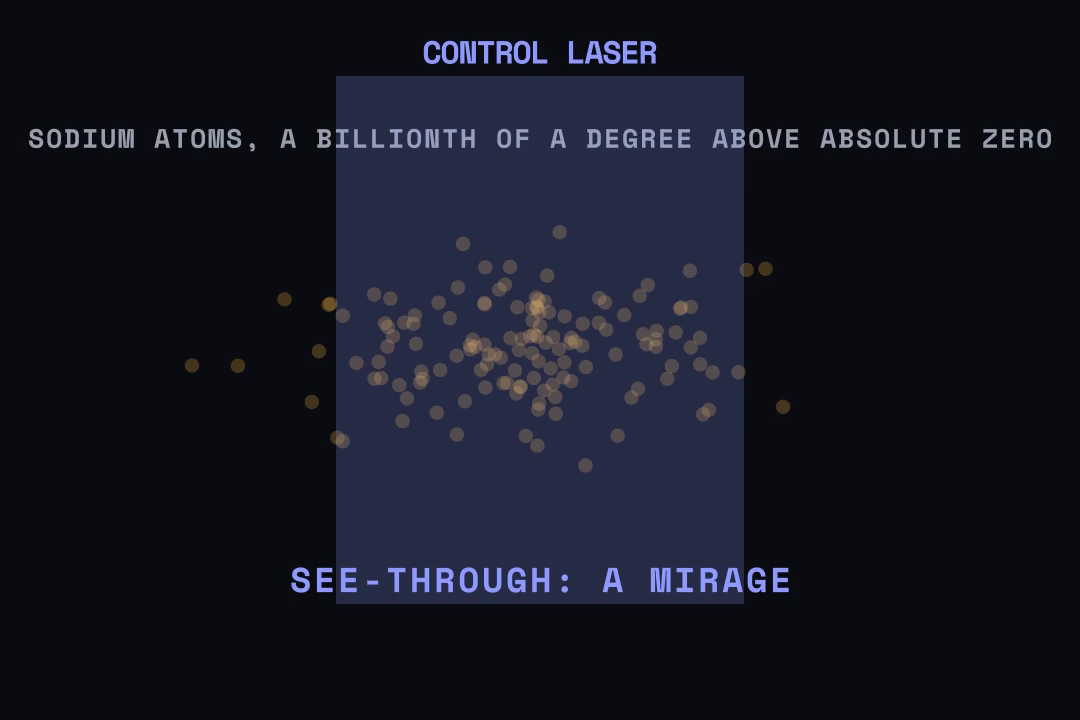 Schematic: the control laser turns an opaque cloud transparent.
Inside that transparent cloud the light doesn’t simply pass one atom at a time. It spreads through the cloud, sharing itself with the atoms, and it slows down dramatically. In 1999 the team reported in Nature that light had slowed to 17 metres a second, about the speed of a car in town.
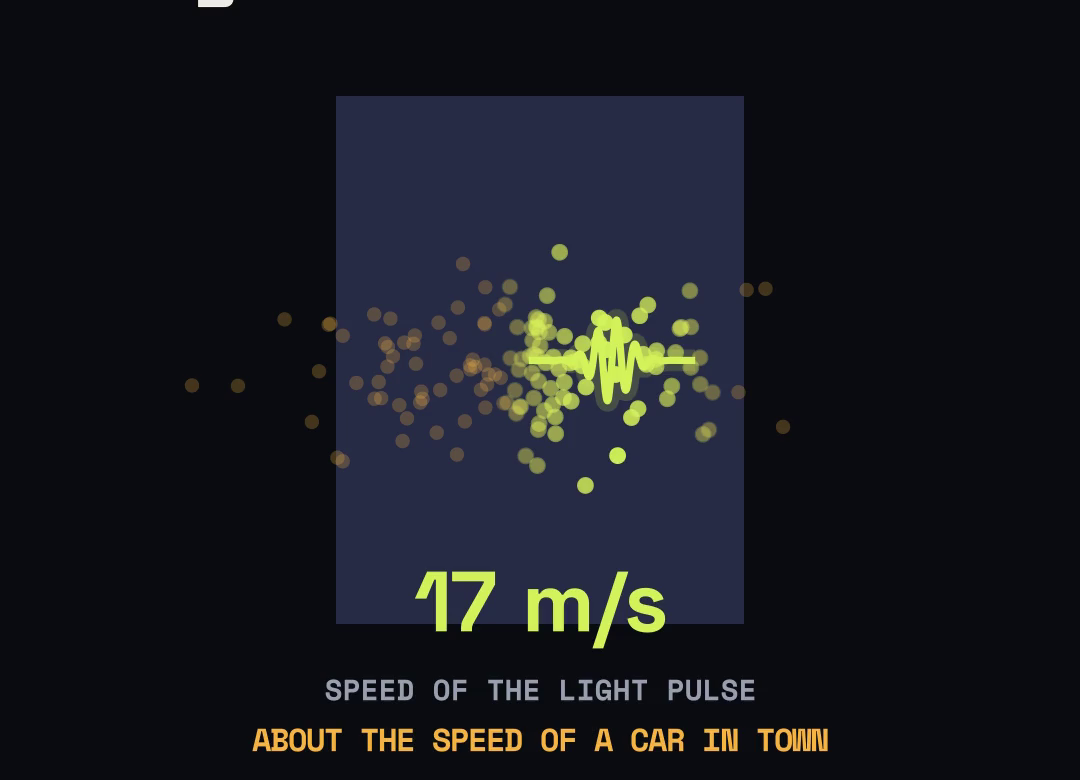 From 300,000 km/s to 17 m/s.
How slow, in one line
Light’s speed in any material is v = c / n, where c is its speed in empty space and n (strictly, the group index) measures how strongly the material holds it back. Glass holds light back about 1.5 times. Hau’s cloud held it back roughly 18 million times.
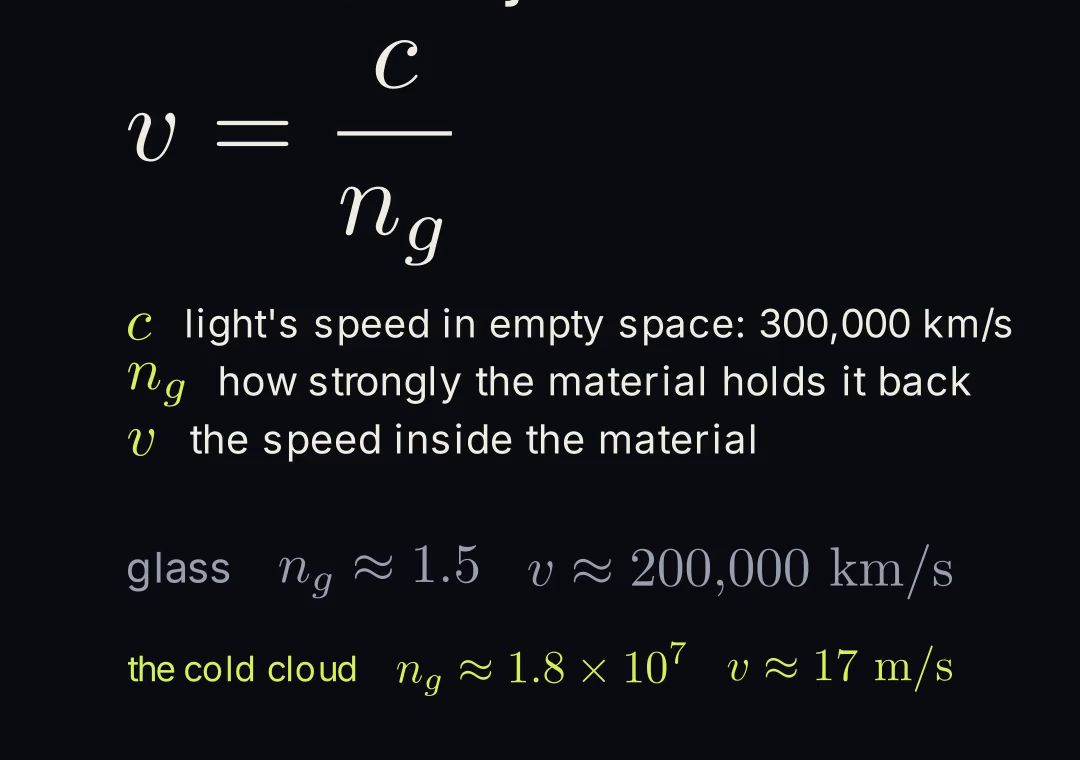 Same equation, very different materials.
Switch it off, and the light is caught
In 2001 the team went further. With a pulse slowed inside the cloud, they switched the control laser off. The transparency vanished and the pulse disappeared, but its shape and phase were imprinted on the sodium atoms. The light was, in effect, caught, like a mouse that walks into a cage just before the door shuts. About a thousandth of a second later they switched the laser back on, and the same pulse came back out and left the cloud at full speed. A second Harvard team, at the Harvard-Smithsonian Center for Astrophysics, reported storing light in an atomic vapour the same year.
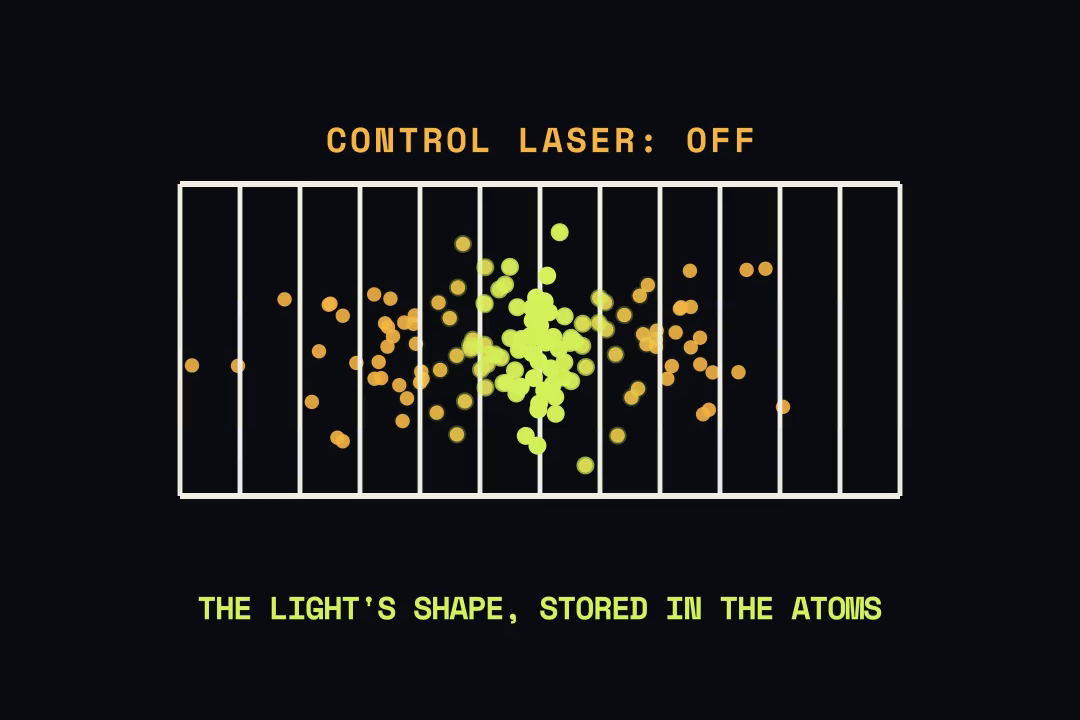 Laser off: the pulse’s shape is held in the atoms until the laser comes back on.
Why it matters
Storing light and releasing it on demand is the basic idea behind quantum memories, which future quantum networks will need to hold fragile quantum information while it waits to be passed on. Since these first experiments, researchers have stored light for longer and in solid crystals and chips as well as gases.
These experiments are from 1999 and 2001, not new research; we’re telling the story because the “light turned solid” headline keeps resurfacing. The storage time here was about a thousandth of a second, and it required atoms cooled almost to absolute zero.
It’s as if a soul were breathed into matter, to be drawn out again, and asked to give its account, when the time comes.
Sources
- Light speed reduction to 17 metres per second in an ultracold atomic gas, Hau, Harris, Dutton & Behroozi, Nature 397 (1999)
- Observation of coherent optical information storage in an atomic medium using halted light pulses, Liu, Dutton, Behroozi & Hau, Nature 409 (2001)
- Researchers now able to stop, restart light, Harvard Gazette (2001)
- Italian scientists freeze a ray of light, Science India (2025) (the viral headline; that study, in Nature in March 2025, made light behave as a supersolid, a different experiment)