
Quantum computing
Your laptop can fake a noisy quantum computer
A new proof shows that once noise builds up locally, an ordinary computer can sample the output of noisy quantum circuits efficiently, at a depth that doesn't grow with the size of the chip.
Quantum computers are supposed to do things no ordinary computer can. But today’s chips are noisy, and a new proof shows that once that noise builds up, an ordinary computer can copy them, at least for a broad class of circuits.
A little noise, every step
In real hardware, every qubit has a small chance p of being scrambled at each step. Noise slowly erases the quantum information that makes these machines hard to simulate. The question is how quickly.
The old view: bigger chips are safer
Earlier classical sampling methods needed the circuit to be deep enough for noise to push the whole chip’s output close to a trivial state, and that depth grew with the logarithm of the number of qubits. That suggested bigger chips would stay out of reach for longer.
The new result: a fixed depth is enough
The authors prove that local build-up of noise is already sufficient. For geometrically local circuits (qubits interact only with their neighbours) made of unital operations with single-qubit depolarizing noise of strength p, once the depth exceeds about (1/p)·log(1/p), a classical computer can approximately sample the output in polynomial time. That depth depends on the noise, not on the size of the chip.
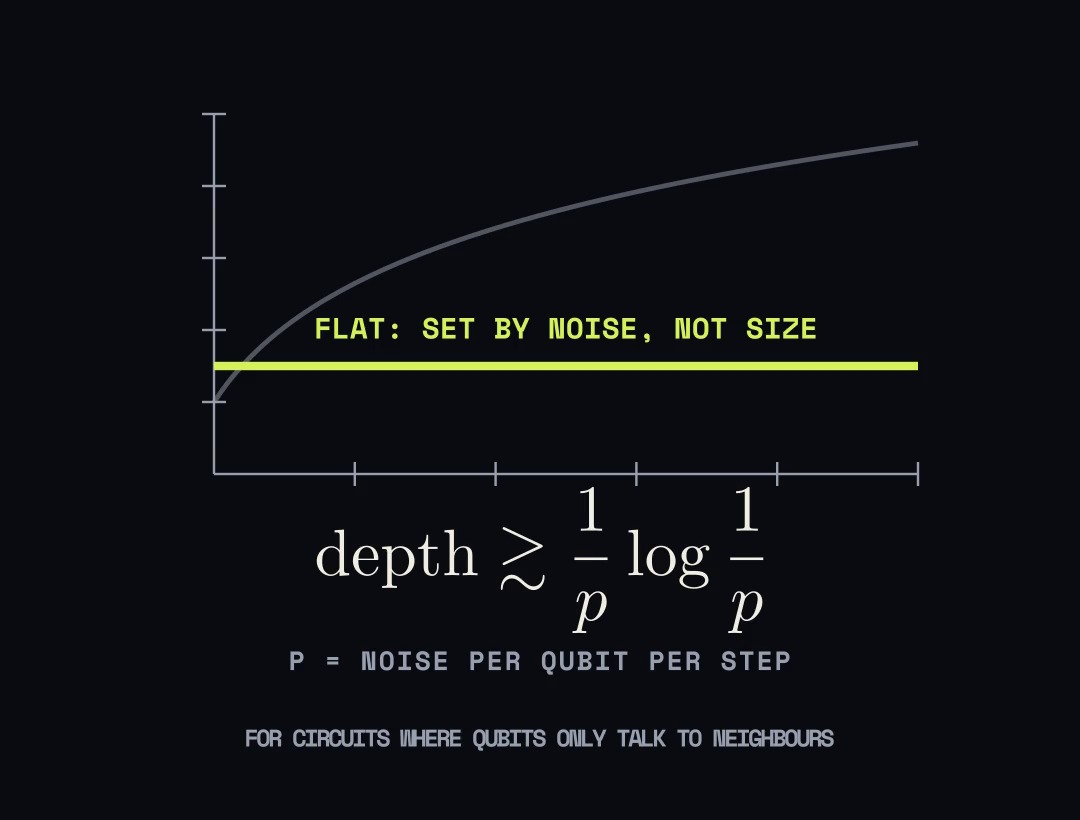 Depth ≳ (1/p)·log(1/p), independent of chip size (curves schematic).
The proof borrows from statistical mechanics: the circuit’s output is mapped to a “polymer model”, and a convergent cluster expansion, combined with a property of depolarizing noise called hypercontractivity, shows it can be computed efficiently.
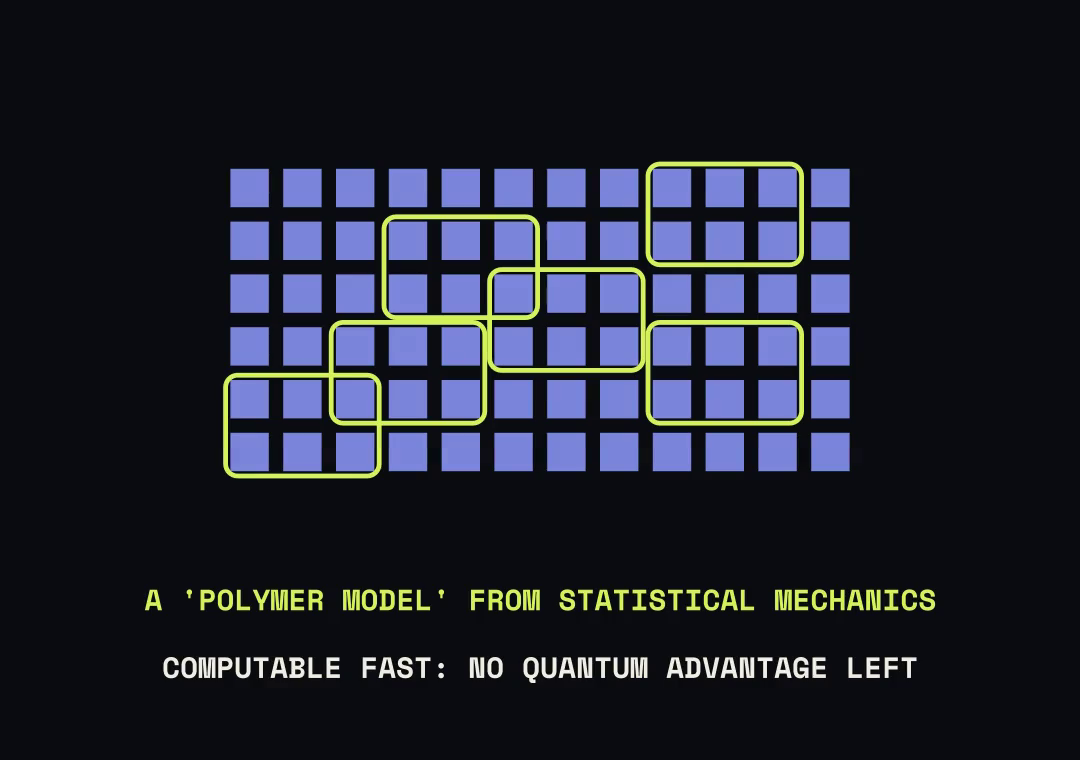 The polymer picture (schematic).
Why it matters
Claims of quantum advantage on noisy hardware have to beat the best classical simulations. This result draws a clearer line: deep, noisy, local circuits without error correction can be simulated, so advantage has to come from shallow circuits or from error-corrected machines.
The result applies to geometrically local circuits with this kind of noise; it says nothing about error-corrected quantum computers, and “polynomial time” can still mean a lot of computing in practice. It’s a preprint and hasn’t been peer-reviewed.
Without error correction, deep noisy quantum circuits lose their edge.
Sources
Second Look promised We'll give this a Second Look when it's peer-reviewed.