
Medicine
Why a heart attack can hurt in your arm
A new theoretical paper models where we feel pain as the brain's best guess from nerve signals, and shows that guess can fail in four distinct ways.
A heart attack can hurt in the left arm rather than the chest. Where we feel pain is sometimes decisive for a diagnosis and sometimes almost useless. A new paper by Adam Y. Shavit argues that these aren’t random quirks: they are one inference failing at different points.
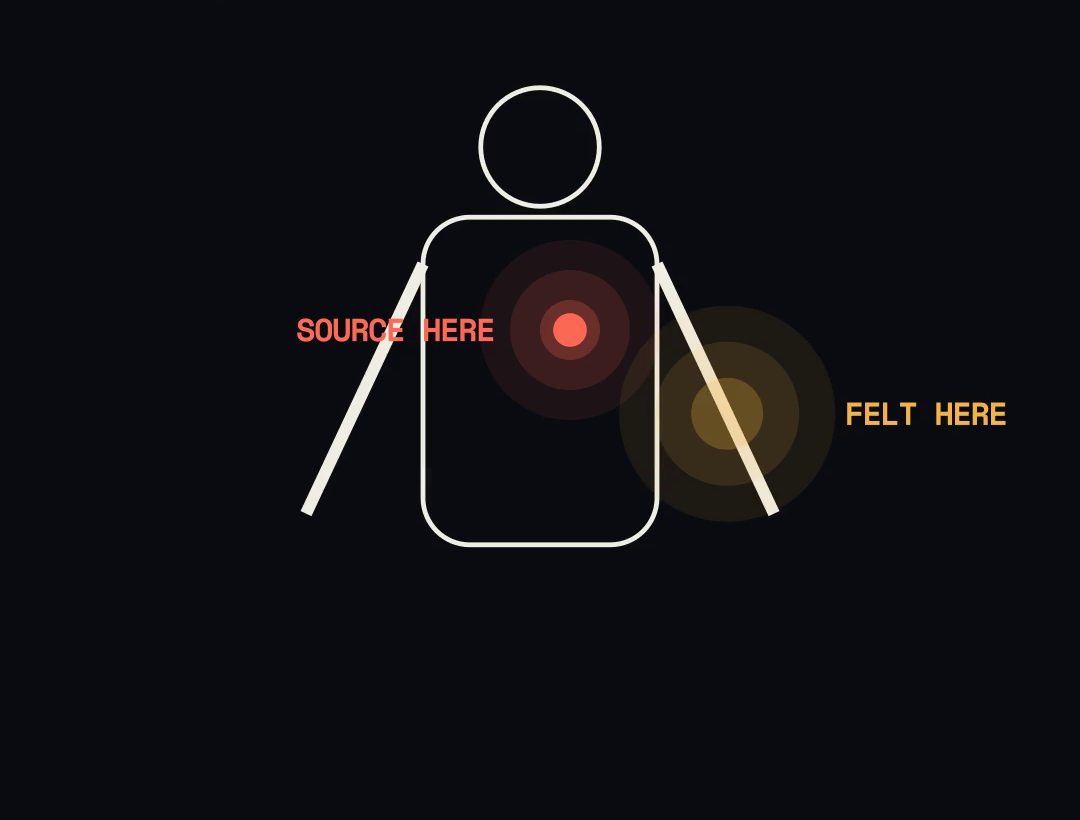 Source in one place, felt in another (schematic).
Pain location as a best guess
The model treats felt pain location as Bayesian inference: the brain receives nerve signals and works out the most probable source. Framed that way, the paper identifies four ways the guess can go wrong.
- Shared wires (anatomical multiplexing). Different body parts can send signals along the same pathways, so different causes map to the same felt spot. Mathematically the problem can’t be inverted: the information to tell them apart isn’t in the signal.
- Spreading pain (delocalized amplification). Pain can expand and lose its location, which the paper models as a sudden change in the dynamics of a neural field.
- Different presentations in different groups. The same condition can show up differently depending on who the patient is, so the best diagnostic threshold depends on how common the condition is in that group and on the cost of missing it.
- The report itself. Even a correctly felt location can be blurred or shifted when people describe it, and the model reproduces phantom-limb and mirror-box reports.
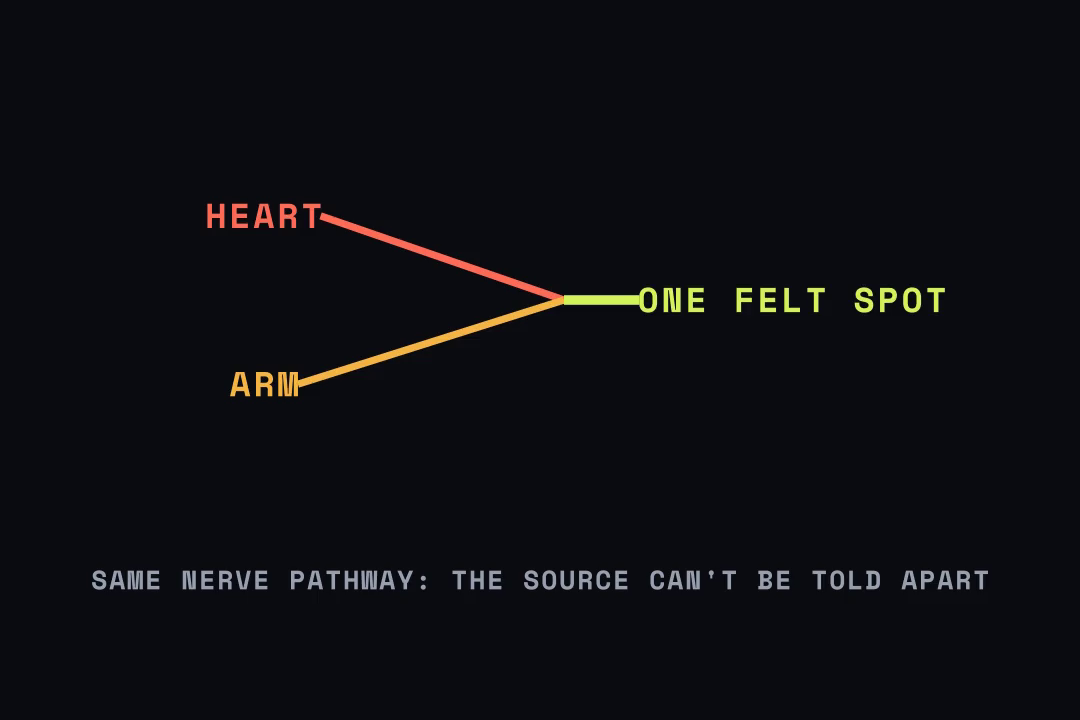 Failure 1: two sources, one pathway, one felt spot.
The paper also shows a limit: asking the patient again doesn’t recover information that the shared pathway has already erased.
Why it matters
Doctors already know referred pain exists. A single model that separates four kinds of failure tells them which kind they are facing, and therefore whether a better question, a test, or a different threshold for a particular group will actually help.
This is a theoretical paper in a preprint, with no new patient data, and it hasn’t been peer-reviewed. It is not medical advice: chest or arm pain can be an emergency.
Where pain seems to be is an educated guess, and knowing how that guess fails helps doctors read it.
Sources
- One Inference, Four Failure Modes: Formal Models of Why Pain Location Fails, Adam Y. Shavit, arXiv 2610.00866 (1 Oct 2026) (theoretical preprint; no new patient data)
Second Look promised We'll give this a Second Look when it's peer-reviewed.