
Physics
A Nobel for a telescope made of ice
Francis Halzen wins the 2026 Nobel Prize in Physics for IceCube, a detector built into a cubic kilometre of Antarctic ice that found the first high-energy neutrinos from beyond the solar system.
Trillions of neutrinos pass through your body every second, and almost none of them touch a single atom on the way. To catch the rare ones that do, Francis Halzen helped turn a cubic kilometre of Antarctic ice into a telescope. That idea has now won the 2026 Nobel Prize in Physics.
Who won, and for what
The prize goes to Francis Halzen, a Belgium-born physicist at the University of Wisconsin–Madison and principal investigator of the IceCube Neutrino Observatory. The Nobel citation honours his “decisive contributions to the IceCube Neutrino Observatory and the discovery of high-energy neutrinos of astrophysical origin”.
IceCube came online in 2010. Most telescopes collect light. IceCube collects neutrinos instead, and within a couple of years of operation it had confirmed the first high-energy neutrinos from beyond the solar system.
Why you need a cubic kilometre
Neutrinos are among the least understood particles in physics, and they are famously antisocial: they move through matter almost as if it isn’t there. A detector only sees one when it happens to strike an atom, which is extremely rare. The only way to catch enough of them is to watch an enormous volume of material.
So IceCube is enormous. According to the observatory, it has 5,160 digital optical modules, each built around a ten-inch light sensor. They hang on 86 vertical strings frozen into boreholes, filling a cubic kilometre of ice between 1,450 and 2,450 metres below the surface. The holes were melted out with jets of hot water, and the strings lowered in before the ice refroze around them.
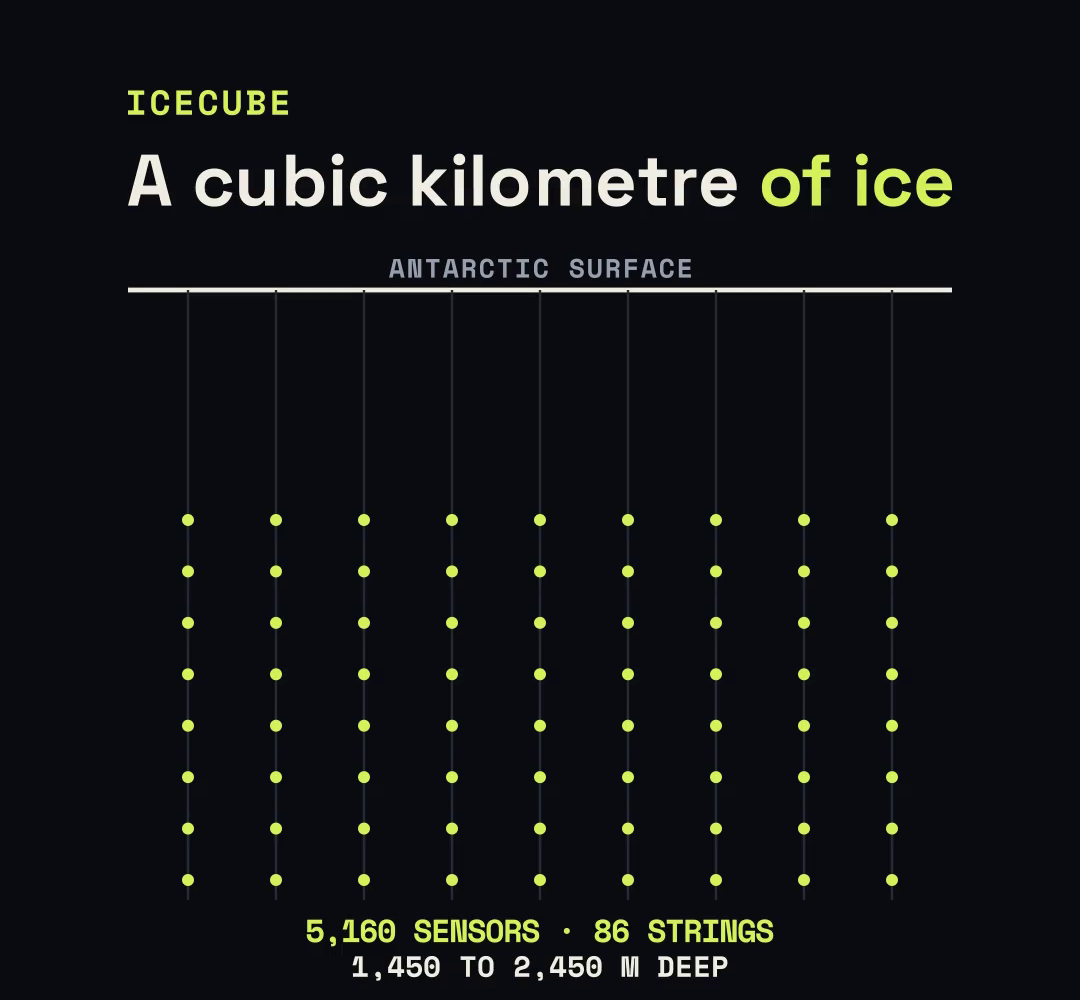 IceCube’s strings of light sensors, frozen deep into the Antarctic ice (schematic, not to scale).
How a block of ice sees
When a neutrino does hit the ice, it produces an electrically charged particle. That particle can travel faster than light travels through ice (still slower than light in a vacuum), and when it does it gives off a faint cone of blue light called Cherenkov radiation, a little like the optical version of a sonic boom.
The deep Antarctic ice is extraordinarily clear, so that light travels a long way. The sensors record when and how brightly the flash reaches each of them, and from that pattern physicists rebuild the neutrino’s energy and the direction it came from. Point that direction back out into space and you have a telescope that sees in neutrinos instead of light.
Why it matters
Neutrinos travel from their sources almost untouched: they aren’t absorbed by dust and aren’t bent by magnetic fields. That makes them clean messengers from the most violent places in the universe, such as the cores of distant galaxies. IceCube’s detections helped launch what astronomers call multimessenger astronomy, where neutrinos, ordinary telescopes and gravitational-wave detectors look at the same event together.
It was also a gamble. As Scientific American reports, nobody knew in advance whether the cosmic sources would be bright enough in neutrinos to be seen at all. Halzen made the case, got the proposals through review, and the bet paid off.
The catch
Seeing high-energy cosmic neutrinos is not the same as knowing exactly where they all come from. Many of the sources are still being pinned down, and IceCube remains one detector with a finite view. Its future also depends on funding: Scientific American notes that the US administration’s 2027 budget proposal calls for halving IceCube’s funding.
A frozen cubic kilometre at the bottom of the world turned out to be one of the best windows we have on the far side of the universe.