
Economics
Why a fixed money budget protects you from price hikes
A new economics paper argues that committing to spend a fixed amount, rather than buy a fixed quantity, takes away a powerful seller's reason to raise prices on you.
Some people budget their coffee in money: “2,000 a month, whatever happens.” Others budget in cups: “thirty a month, no matter what.” A new paper argues the first habit does something the second doesn’t: it quietly takes away a seller’s power to raise prices on you.
Money jars in your head
Economists call it mental accounting: keeping separate pots in your head for coffee, clothes, eating out and so on, and not letting money flow freely between them. Strictly speaking it looks irrational, since money is money. The usual explanation is self-control. Jars stop you overspending on things you’ll regret.
Jarrod Burgh, Emerson Melo and Matthew Shum offer a third explanation, separate from self-control and from the standard theory of two-stage budgeting: protection against a seller’s market power.
The arithmetic of a fixed budget
A seller’s takings are simply price times quantity. Suppose you commit to spending a fixed amount B on coffee each month. Then price × cups = B, whatever the price. If the café raises its price, you buy fewer cups, and its takings stay exactly B.
Economists call this unit-elastic demand. A seller facing it gains nothing by restricting quantity and pushing the price up, because revenue doesn’t move.
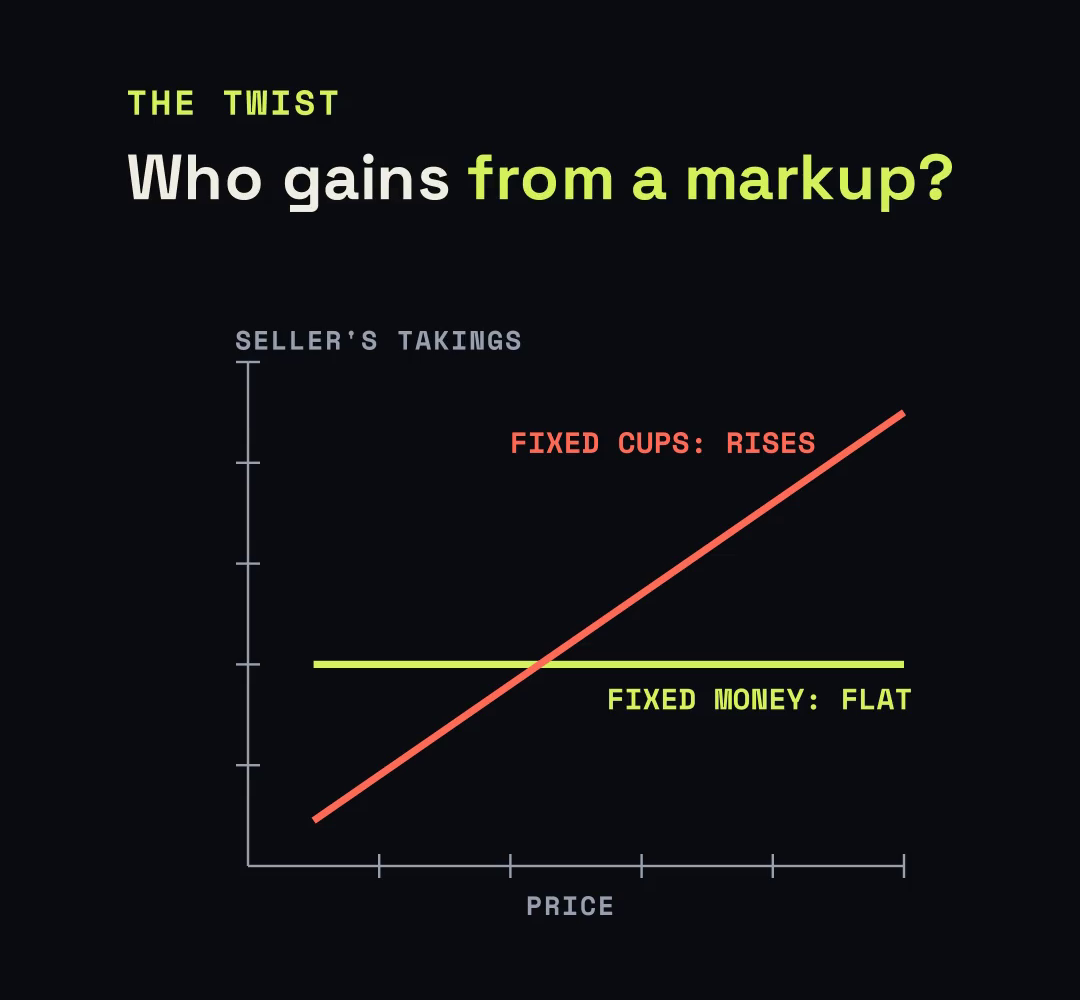 Fixed money: the seller’s takings stay flat as the price rises. Fixed cups: they rise with it (schematic).
Now suppose you insist on a fixed quantity instead: thirty cups, no matter what. Your demand is perfectly inelastic. Every price rise goes straight into the seller’s pocket, and a monopolist can exploit that as far as you’ll let it.
What the paper proves
The authors characterise which spending commitments remove a seller’s incentive to mark up prices, and show that the fixed money budget is the least restrictive of them. It is the loosest rule that still does the job.
They also show that what matters is rigidity, not the separate jars themselves. A consumer who re-optimises their category budget whenever prices change is protected from market power only if the categories are substitutes for one another. A rigid budget, one that doesn’t move, protects them in every case. On this reading, mental accounting is a commitment device against markups.
Why it matters
Behavioural economics often treats mental accounting as a bias to be corrected. This paper gives it a rational job: if you face sellers with pricing power, refusing to let your spending in a category rise with the price disciplines them. It also gives a concrete rule for anyone with a budget: set categories in money, not in quantities, and don’t renegotiate them every time the price moves.
The catch
This is a preprint and hasn’t been peer reviewed. It’s a theory paper, not a field study, so it doesn’t measure how much real shoppers save. The argument is about sellers with market power, such as a monopolist. It doesn’t claim that fixed budgets lower prices in competitive markets, where sellers can’t raise prices freely anyway.
The coffee jar in your head might be doing more than keeping you disciplined: it may be keeping the café honest too.
Sources
Second Look promised We'll give this a Second Look when it's peer-reviewed.