
Physics
A bubble of atoms that acts out the birth of a universe
A theory proposal shows how a hollow shell of ultracold atoms could act out an expanding, curved universe in the lab, complete with entangled pairs and ripples like those in the cosmic microwave background.
We can’t rerun the Big Bang. A new theory proposal suggests the next best thing: a hollow bubble of atoms, cooled to almost absolute zero, that acts out a tiny, curved universe on a lab bench.
A bubble made of one quantum wave
When atoms are cooled enough they form a Bose-Einstein condensate (BEC), in which they behave together as a single quantum wave. Labs have recently realised BECs in shell-shaped, or “bubble”, traps, a thin hollow sphere of quantum gas. Ruotong Zhai and colleagues ask whether such a bubble can stand in for a universe.
Changing the sound speed stretches the space
Sound waves in the condensate travel at a speed set by how strongly the atoms interact. The authors study a quench, a change of that interaction strength over time, either decaying or growing exponentially. They show that, for the sound waves living on the shell, this is mathematically like a positively curved universe whose scale factor changes in time. To the waves, space itself is stretching or shrinking.
That’s the trick of analog gravity: you don’t need to make anything the size of the cosmos. You need equations that match.
Pairs from nothing, and they’re entangled
In the early universe, rapidly changing space creates particle pairs out of the vacuum. In the bubble, the same maths makes pairs of excitations, quanta of sound, appear spontaneously when the interaction strength is quenched.
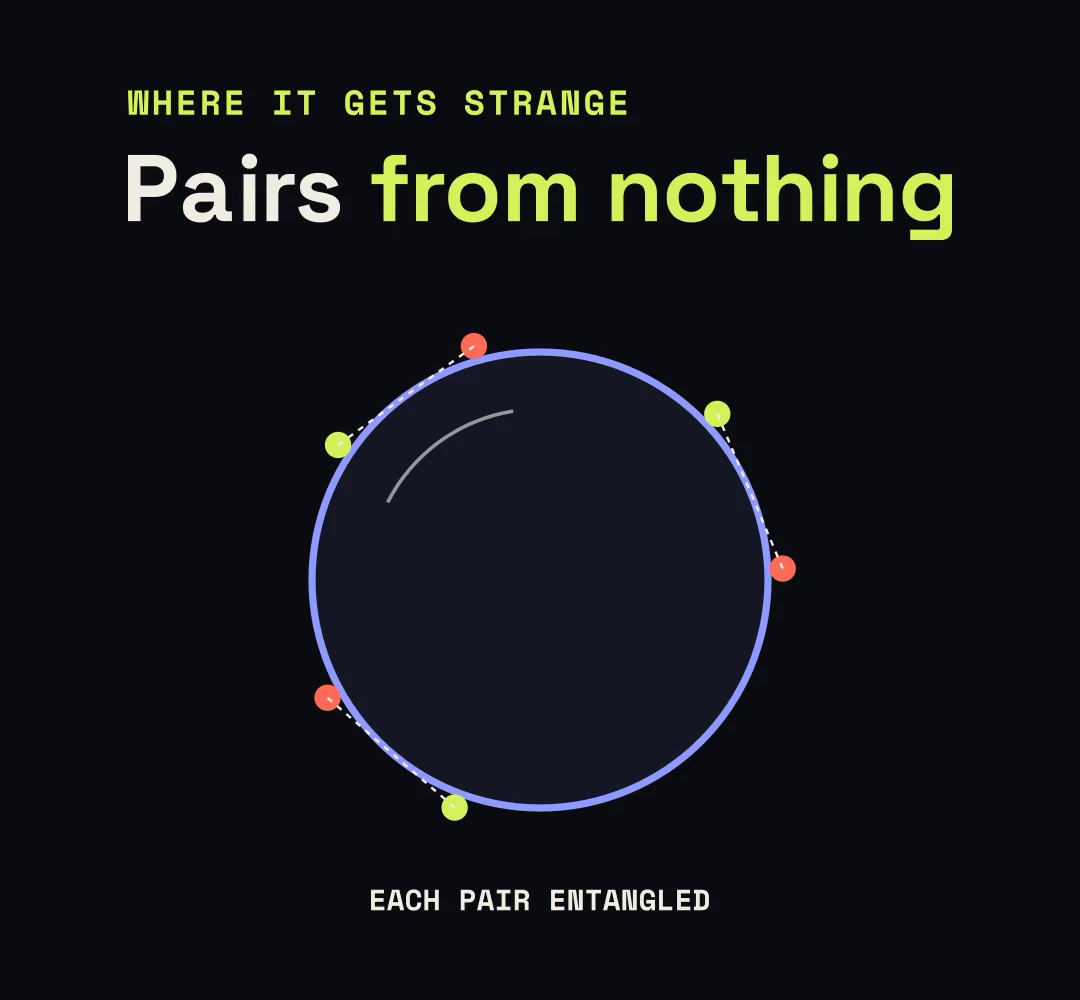 Quenching the interactions makes pairs of sound waves appear on the shell, each pair entangled (schematic).
These pairs leave a fingerprint: oscillations in the structure factor, a measure of how density ripples are spread across scales. The authors note these are analogous to the Sakharov oscillations in the cosmic microwave background’s angular power spectrum, the ripple pattern astronomers measure in the oldest light in the universe. They also quantify how entangled the pairs are, using a measure called logarithmic negativity, and show it can be extracted from the power spectrum itself.
Why it matters
It links quantum information science with early-universe cosmology in a system that could actually be built. Ideas about how particles and correlations emerge from an expanding universe could, in principle, be tested in a controllable experiment.
The catch
This is a theory proposal and a preprint that hasn’t been peer reviewed. No experiment has been done yet. An analog universe reproduces the maths of certain processes, not the real cosmos, so what it can tell us about the actual Big Bang depends on how far the analogy holds.
To test how a universe begins, you might only need a bubble of very cold atoms.
Sources
Second Look promised We'll give this a Second Look when it's peer-reviewed or tested in the lab.