
Physics
Pull rubber slowly and the tear runs sideways
In rubber packed with tiny filler particles, a crack swings further off course the slower you pull, and those wandering cracks break the material with up to 100 times less energy.
Tear a strip of rubber quickly and the crack usually runs straight across. A new study finds that in one common kind of rubber, pulling slowly does something unexpected: the crack veers off sideways, and the material gives way far more easily.
The usual picture: fast cracks go wild
In most solids, cracks only become unstable when they move fast. A fast-running crack can wobble, branch or curve. A slow one tends to follow the straightest path. That’s the textbook intuition.
The experiment
Physicists G. Pallares, O. Ramos and L. Vanel tested nanoparticle-filled elastomers: rubber packed with tiny filler particles. They pulled samples apart at a range of speeds and tracked the path the crack took.
Slower means more sideways
They found a sideways crack-path instability that behaves the opposite way to the textbook picture. It is amplified as the pulling speed decreases and nearly vanishes when the rubber is pulled fast.
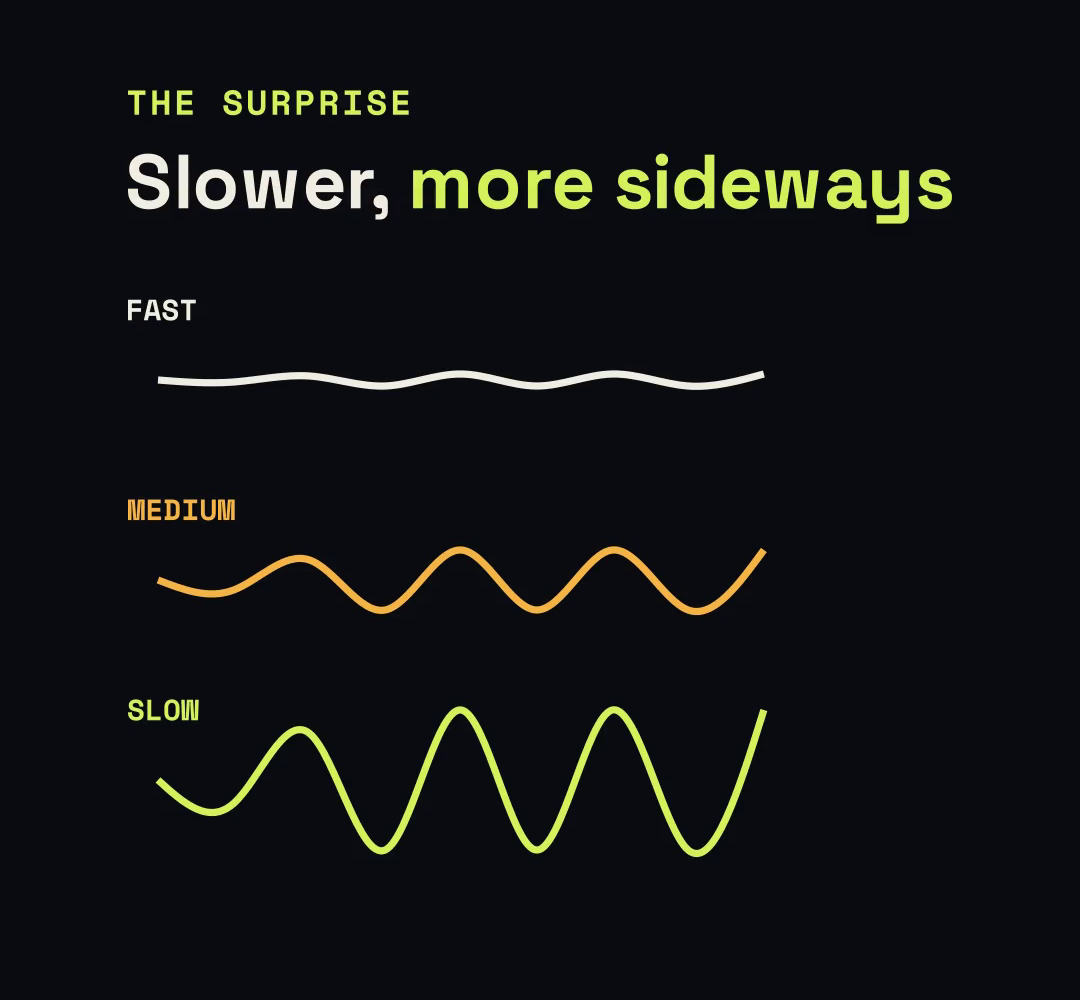 The slower the pull, the further the crack swings (schematic).
The swing follows two simple relations:
- its size falls with the logarithm of the pulling speed, so every tenfold slowdown adds a similar amount of swing;
- its size grows with the square root of the filler fraction, the share of the rubber taken up by the particles.
Why it matters: much easier to break
The large sideways deviations appeared at low average crack speeds and came with effective fracture energies up to two orders of magnitude lower. In other words, when the crack wanders, the rubber can break with up to a hundred times less energy than you’d expect.
The authors say this fits “subcritical” rupture: the crack creeps forward in small steps under a load that wouldn’t break the material in one go. They suggest the size of the swing is limited by the rubber’s elasto-adhesive length, a scale set by how sticky and how stretchy the material is.
Filled rubbers are everywhere, so a failure mode that gets worse under slow loading is worth knowing about for anything that is stretched gently over a long time.
The catch
This is a preprint and hasn’t been peer reviewed. The result is for nanoparticle-filled elastomers; the abstract doesn’t claim it holds for unfilled rubber or other materials. The mechanism (subcritical rupture capped by the elasto-adhesive length) is the authors’ interpretation of the data, described as consistent with it rather than proven.
Sometimes the slow, gentle pull is the one that does the real damage.
Sources
Second Look promised We'll give this a Second Look when it's peer-reviewed.